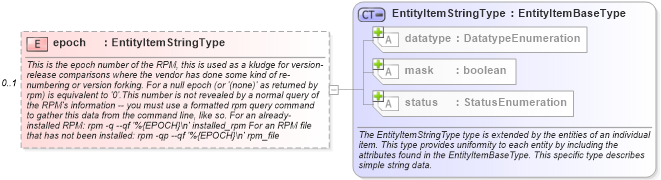
<xsd:element name="epoch" type="oval-sc:EntityItemStringType" minOccurs="0" maxOccurs="1">
    <xsd:annotation>
        <xsd:documentation>This is the epoch number of the RPM, this is used as a kludge for version-release comparisons where the vendor has done some kind of re-numbering or version forking. For a null epoch (or '(none)' as returned by rpm) is equivalent to '0'.This number is not revealed by a normal query of the RPM's information -- you must use a formatted rpm query command to gather this data from the command line, like so. For an already-installed RPM: rpm -q --qf '%{EPOCH}\n' installed_rpm For an RPM file that has not been installed: rpm -qp --qf '%{EPOCH}\n' rpm_file</xsd:documentation>
        <xsd:appinfo>
            <sch:pattern id="rpmitemepoch" xmlns:sch="http://purl.oclc.org/dsdl/schematron">
                <sch:rule context="linux-sc:rpminfo_item/linux-sc:epoch">
                    <sch:assert test="not(@datatype) or @datatype='string'">item <sch:value-of select="../@id" /> - datatype attribute for the epoch entity of a rpminfo_item should be 'string'</sch:assert>
                </sch:rule>
            </sch:pattern>
        </xsd:appinfo>
    </xsd:annotation>
</xsd:element>
|
 XSD Schema Diagram: