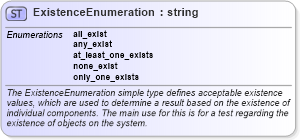
<xsd:simpleType name="ExistenceEnumeration">
    <xsd:annotation>
        <xsd:documentation>The ExistenceEnumeration simple type defines acceptable existence values, which are used to determine a result based on the existence of individual components. The main use for this is for a test regarding the existence of objects on the system.</xsd:documentation>
        <xsd:appinfo>
            <evaluation_documentation>Below are some tables that outline how each ExistenceEnumeration value effects evaluation. The far left column identifies the ExistenceEnumeration value in question. The middle column specifies the different combinations of individual item status flags that the attribute may bind together. (EX=exists, DE=does not exist, ER=error, NC=not collected) For example, a 1+ under EX means that one or more individual item flags are set to exists, while a 0 under NC means that zero individual item flags are set to not collected. The last column specifies what the final result would be according to each combination of individual item flags. Note that if the individual test is negated, then a true result is false and a false result is true, all other results stay as is.</evaluation_documentation>
            <evaluation_chart xml:space="preserve">
               || item status value count   ||
  attr value   ||                           ||  final result is
               ||  EX  |  DE  |  ER  |  NC  ||
---------------||---------------------------||------------------
               ||  1+  |  0   |  0   |  0   ||  True
               ||  0   |  0   |  0   |  0   ||  False
               ||  0+  |  1+  |  0+  |  0+  ||  False
 all_exist     ||  0+  |  0   |  1+  |  0+  ||  Error
               ||  0+  |  0   |  0   |  1+  ||  Unknown
               ||  --  |  --  |  --  |  --  ||  Not Evaluated
               ||  --  |  --  |  --  |  --  ||  Not Applicable
---------------||---------------------------||------------------
                    </evaluation_chart>
            <evaluation_chart xml:space="preserve">
               || item status value count   ||
  attr value   ||                           ||  final result is
               ||  EX  |  DE  |  ER  |  NC  ||
---------------||---------------------------||------------------
               ||  0+  |  0+  |  0   |  0+  ||  True
               ||  1+  |  0+  |  1+  |  0+  ||  True
               ||  --  |  --  |  --  |  --  ||  False
 any           ||  0   |  0+  |  1+  |  0+  ||  Error
               ||  --  |  --  |  --  |  --  ||  Unknown
               ||  --  |  --  |  --  |  --  ||  Not Evaluated
               ||  --  |  --  |  --  |  --  ||  Not Applicable
---------------||---------------------------||------------------
                    </evaluation_chart>
            <evaluation_chart xml:space="preserve">
               || item status value count   ||
  attr value   ||                           ||  final result is
               ||  EX  |  DE  |  ER  |  NC  ||
---------------||---------------------------||------------------
               ||  1+  |  0+  |  0+  |  0+  ||  True
               ||  0   |  1+  |  0   |  0   ||  False
 at_least_one  ||  0   |  0+  |  1+  |  0+  ||  Error
               ||  0   |  0+  |  0   |  1+  ||  Unknown
               ||  --  |  --  |  --  |  --  ||  Not Evaluated
               ||  --  |  --  |  --  |  --  ||  Not Applicable
---------------||---------------------------||------------------
                    </evaluation_chart>
            <evaluation_chart xml:space="preserve">
               || item status value count   ||
  attr value   ||                           ||  final result is
               ||  EX  |  DE  |  ER  |  NC  ||
---------------||---------------------------||------------------
               ||  0   |  0+  |  0   |  0   ||  True
               ||  1+  |  0+  |  0+  |  0+  ||  False
 none          ||  0   |  0+  |  1+  |  0+  ||  Error
               ||  0   |  0+  |  0   |  1+  ||  Unknown
               ||  --  |  --  |  --  |  --  ||  Not Evaluated
               ||  --  |  --  |  --  |  --  ||  Not Applicable
---------------||---------------------------||------------------
                    </evaluation_chart>
            <evaluation_chart xml:space="preserve">
               || item status value count   ||
  attr value   ||                           ||  final result is
               ||  EX  |  DE  |  ER  |  NC  ||
---------------||---------------------------||------------------
               ||  1   |  0+  |  0   |  0   ||  True
               ||  2+  |  0+  |  0+  |  0+  ||  False
               ||  0   |  0+  |  0   |  0   ||  False
 only_one      ||  0,1 |  0+  |  1+  |  0+  ||  Error
               ||  0,1 |  0+  |  0   |  1+  ||  Unknown
               ||  --  |  --  |  --  |  --  ||  Not Evaluated
               ||  --  |  --  |  --  |  --  ||  Not Applicable
---------------||---------------------------||------------------
                    </evaluation_chart>
        </xsd:appinfo>
    </xsd:annotation>
    <xsd:restriction base="xsd:string">
        <xsd:enumeration value="all_exist">
            <xsd:annotation>
                <xsd:documentation>A value of 'all_exist' means that every object defined by the description exists on the system.</xsd:documentation>
            </xsd:annotation>
        </xsd:enumeration>
        <xsd:enumeration value="any_exist">
            <xsd:annotation>
                <xsd:documentation>A value of 'any_exist' means that zero or more objects defined by the description exist on the system.</xsd:documentation>
            </xsd:annotation>
        </xsd:enumeration>
        <xsd:enumeration value="at_least_one_exists">
            <xsd:annotation>
                <xsd:documentation>A value of 'at_least_one_exists' means that at least one object defined by the description exists on the system.</xsd:documentation>
            </xsd:annotation>
        </xsd:enumeration>
        <xsd:enumeration value="none_exist">
            <xsd:annotation>
                <xsd:documentation>A value of 'none_exist' means that none of the objects defined by the description exist on the system.</xsd:documentation>
            </xsd:annotation>
        </xsd:enumeration>
        <xsd:enumeration value="only_one_exists">
            <xsd:annotation>
                <xsd:documentation>A value of 'only_one_exists' means that only one object defined by the description exists on the system.</xsd:documentation>
            </xsd:annotation>
        </xsd:enumeration>
    </xsd:restriction>
</xsd:simpleType>
|
 XSD Schema Diagram:
 Facets: