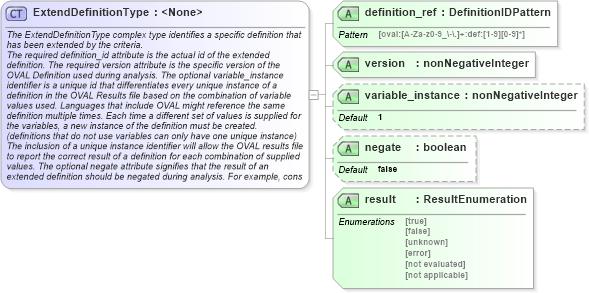
<xsd:complexType name="ExtendDefinitionType">
    <xsd:annotation>
        <xsd:documentation>The ExtendDefinitionType complex type identifies a specific definition that has been extended by the criteria.</xsd:documentation>
        <xsd:documentation>The required definition_id attribute is the actual id of the extended definition. The required version attribute is the specific version of the OVAL Definition used during analysis. The optional variable_instance identifier is a unique id that differentiates every unique instance of a definition in the OVAL Results file based on the combination of variable values used. Languages that include OVAL might reference the same definition multiple times. Each time a different set of values is supplied for the variables, a new instance of the definition must be created. (definitions that do not use variables can only have one unique instance) The inclusion of a unique instance identifier will allow the OVAL results file to report the correct result of a definition for each combination of supplied values. The optional negate attribute signifies that the result of an extended definition should be negated during analysis. For example, consider a definition that evaluates TRUE if a certain software is installed. By negating the definition, it now evaluates to TRUE if the software is NOT installed. The required result attribute holds the result of the evaluation. Please refer to the description of the resultEnumeration for details about the different result values.</xsd:documentation>
    </xsd:annotation>
    <xsd:attribute name="definition_ref" type="oval:DefinitionIDPattern" use="required" />
    <xsd:attribute name="version" type="xsd:nonNegativeInteger" use="required" />
    <xsd:attribute name="variable_instance" type="xsd:nonNegativeInteger" use="optional" default="1" />
    <xsd:attribute name="negate" type="xsd:boolean" use="optional" default="false" />
    <xsd:attribute name="result" type="oval-res:ResultEnumeration" use="required" />
</xsd:complexType>
|
 XSD Schema Diagram: