<xsd:simpleType name="FlagEnumeration">
    <xsd:annotation>
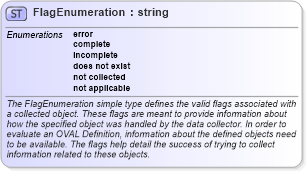
        <xsd:documentation>The FlagEnumeration simple type defines the valid flags associated with a collected object. These flags are meant to provide information about how the specified object was handled by the data collector. In order to evaluate an OVAL Definition, information about the defined objects need to be available. The flags help detail the success of trying to collect information related to these objects.</xsd:documentation>
    </xsd:annotation>
    <xsd:restriction base="xsd:string">
        <xsd:enumeration value="error">
            <xsd:annotation>
                <xsd:documentation>A flag of 'error' says that there was an error trying to identify objects on the system that match the specified object declaration. This flag is not meant to be used when there was an error retrieving a specific attribute, but rather when it could not be determined if an instance of the object exists or not. Any error in retrieving specific attributes should be represented by setting the status of that specific attribute to 'error'.</xsd:documentation>
            </xsd:annotation>
        </xsd:enumeration>
        <xsd:enumeration value="complete">
            <xsd:annotation>
                <xsd:documentation>Every matching item on the system has been identified and is represented in the system characteristics file. It can be assumed that no additional matching items exist on the system.</xsd:documentation>
            </xsd:annotation>
        </xsd:enumeration>
        <xsd:enumeration value="incomplete">
            <xsd:annotation>
                <xsd:documentation>An instance of the specified object exists on the system, but only some of the matching items have been identified and are represented in the system characteristics file. It is unknown if additional matching items also exist. Note that with a flag of incomplete, each item that has been identified matches the object declaration, but additional items might also exist on the system.</xsd:documentation>
            </xsd:annotation>
        </xsd:enumeration>
        <xsd:enumeration value="does not exist">
            <xsd:annotation>
                <xsd:documentation>A flag of 'does not exist' means that the underlying structure is installed on the system but no matching item was found.  For example, the Windows metabase is installed but the specified metabase_object could not be found.  In this example, if the metabase itself was not installed, then the flag would have been 'not applicable'.</xsd:documentation>
            </xsd:annotation>
        </xsd:enumeration>
        <xsd:enumeration value="not collected">
            <xsd:annotation>
                <xsd:documentation>An attempt to collect information on items matching the object was not made. An object with this flag will produce an 'unknown' result during analysis since it is unknown if a matching items exists on the system or not. This is different from an 'error' flag since with an 'error' flag an attempt to collect information was made. With the 'not collected' flag, no attempt was made.</xsd:documentation>
            </xsd:annotation>
        </xsd:enumeration>
        <xsd:enumeration value="not applicable">
            <xsd:annotation>
                <xsd:documentation>The specified object is not applicable to the system being characterized.  This could be because the data repository is not installed or that the object structure is for a different flavor of systems. An example would be trying to collect objects related to a Red Hat system off a Windows system.  Another example would be trying to collect an rpminfo object on a Linux system if the rpm packaging system is not installed.  If the rpm packaging system is installed and the specified rpminfo object could not be found, then the flag would be 'does not exist'.</xsd:documentation>
            </xsd:annotation>
        </xsd:enumeration>
    </xsd:restriction>
</xsd:simpleType>
|
 XSD Schema Diagram:
 Facets: