<xsd:simpleType name="OperatorEnumeration">
    <xsd:annotation>
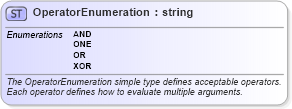
        <xsd:documentation>The OperatorEnumeration simple type defines acceptable operators. Each operator defines how to evaluate multiple arguments.</xsd:documentation>
        <xsd:appinfo>
            <evaluation_documentation>Below are some tables that outline how each operator effects evaluation. The far left column identifies the operator in question. The middle column specifies the different combinations of individual results that the operator may bind together. (T=true, F=false, E=error, U=unknown, NE=not evaluated, NA=not applicable) For example, a 1+ under T means that one or more individual results are true, while a 0 under U means that zero individual results are unknown. The last column specifies what the final result would be according to each combination of individual results. Note that if the individual test is negated, then a true result is false and a false result is true, all other results stay as is.</evaluation_documentation>
            <evaluation_chart xml:space="preserve">
               ||  num of individual results  ||
  operator is  ||                             ||  final result is
               || T  | F  | E  | U  | NE | NA ||
---------------||-----------------------------||------------------
               || 1+ | 0  | 0  | 0  | 0  | 0+ ||  True
               || 0+ | 1+ | 0+ | 0+ | 0+ | 0+ ||  False
      AND      || 0+ | 0  | 1+ | 0+ | 0+ | 0+ ||  Error
               || 0+ | 0  | 0  | 1+ | 0+ | 0+ ||  Unknown
               || 0+ | 0  | 0  | 0  | 1+ | 0+ ||  Not Evaluated
               || 0  | 0  | 0  | 0  | 0  | 1+ ||  Not Applicable
---------------||-----------------------------||------------------
                    </evaluation_chart>
            <evaluation_chart xml:space="preserve">
               ||  num of individual results  ||
  operator is  ||                             ||  final result is
               || T  | F  | E  | U  | NE | NA ||
---------------||-----------------------------||------------------
               || 1  | 0+ | 0  | 0  | 0  | 0+ ||  True
               || 2+ | 0+ | 0+ | 0+ | 0+ | 0+ ||  ** False **
               || 0  | 1+ | 0  | 0  | 0  | 0+ ||  ** False **
      ONE      ||0,1 | 0+ | 1+ | 0+ | 0+ | 0+ ||  Error
               ||0,1 | 0+ | 0  | 1+ | 0+ | 0+ ||  Unknown
               ||0,1 | 0+ | 0  | 0  | 1+ | 0+ ||  Not Evaluated
               || 0  | 0  | 0  | 0  | 0  | 1+ ||  Not Applicable
---------------||-----------------------------||------------------
                    </evaluation_chart>
            <evaluation_chart xml:space="preserve">
               ||  num of individual results  ||
  operator is  ||                             ||  final result is
               || T  | F  | E  | U  | NE | NA ||
---------------||-----------------------------||------------------
               || 1+ | 0+ | 0+ | 0+ | 0+ | 0+ ||  True
               || 0  | 1+ | 0  | 0  | 0  | 0+ ||  False
      OR       || 0  | 0+ | 1+ | 0+ | 0+ | 0+ ||  Error
               || 0  | 0+ | 0  | 1+ | 0+ | 0+ ||  Unknown
               || 0  | 0+ | 0  | 0  | 1+ | 0+ ||  Not Evaluated
               || 0  | 0  | 0  | 0  | 0  | 1+ ||  Not Applicable
---------------||-----------------------------||------------------
                    </evaluation_chart>
            <evaluation_chart xml:space="preserve">
               ||  num of individual results  ||
  operator is  ||                             ||  final result is
               || T  | F  | E  | U  | NE | NA ||
---------------||-----------------------------||------------------
               ||odd | 0+ | 0  | 0  | 0  | 0+ ||  True
               ||even| 0+ | 0  | 0  | 0  | 0+ ||  False
      XOR      || 0+ | 0+ | 1+ | 0+ | 0+ | 0+ ||  Error
               || 0+ | 0+ | 0  | 1+ | 0+ | 0+ ||  Unknown
               || 0+ | 0+ | 0  | 0  | 1+ | 0+ ||  Not Evaluated
               || 0  | 0  | 0  | 0  | 0  | 1+ ||  Not Applicable
---------------||-----------------------------||------------------
                    </evaluation_chart>
        </xsd:appinfo>
    </xsd:annotation>
    <xsd:restriction base="xsd:string">
        <xsd:enumeration value="AND">
            <xsd:annotation>
                <xsd:documentation>The AND operator produces a true result if every argument is true. If one or more arguments are false, the result of the AND is false. If one or more of the arguments are unknown, and if none of the arguments are false, then the AND operator produces a result of unknown.</xsd:documentation>
            </xsd:annotation>
        </xsd:enumeration>
        <xsd:enumeration value="ONE">
            <xsd:annotation>
                <xsd:documentation>The ONE operator produces a true result if one and only one argument is true. If there are more than argument is true (or if there are no true arguements), the result of the ONE is false. If one or more of the arguments are unknown, then the ONE operator produces a result of unknown.</xsd:documentation>
            </xsd:annotation>
        </xsd:enumeration>
        <xsd:enumeration value="OR">
            <xsd:annotation>
                <xsd:documentation>The OR operator produces a true result if one or more arguments is true. If every argument is false, the result of the OR is false. If one or more of the arguments are unknown and if none of arguments are true, then the OR operator produces a result of unknown.</xsd:documentation>
            </xsd:annotation>
        </xsd:enumeration>
        <xsd:enumeration value="XOR">
            <xsd:annotation>
                <xsd:documentation>XOR is defined to be true if an odd number of its arguments are true, and false otherwise. If any of the arguments are unknown, then the XOR operator produces a result of unknown.</xsd:documentation>
            </xsd:annotation>
        </xsd:enumeration>
    </xsd:restriction>
</xsd:simpleType>
|
 XSD Schema Diagram:
 Facets: