<xsd:complexType name="RegkeyEffectiveRightsBehaviors">
    <xsd:annotation>
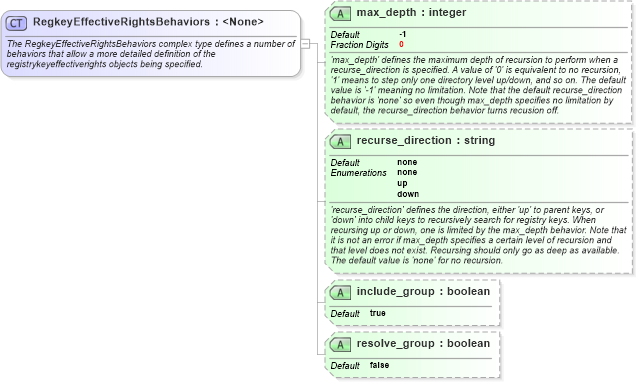
        <xsd:documentation>The RegkeyEffectiveRightsBehaviors complex type defines a number of behaviors that allow a more detailed definition of the registrykeyeffectiverights objects being specified.</xsd:documentation>
    </xsd:annotation>
    <xsd:attribute name="max_depth" use="optional" default="-1">
        <xsd:annotation>
            <xsd:documentation>'max_depth' defines the maximum depth of recursion to perform when a recurse_direction is specified. A value of '0' is equivalent to no recursion, '1' means to step only one directory level up/down, and so on. The default value is '-1' meaning no limitation. Note that the default recurse_direction behavior is 'none' so even though max_depth specifies no limitation by default, the recurse_direction behavior turns recusion off.</xsd:documentation>
        </xsd:annotation>
        <xsd:simpleType>
            <xsd:restriction base="xsd:integer">
                <xsd:fractionDigits value="0" />
            </xsd:restriction>
        </xsd:simpleType>
    </xsd:attribute>
    <xsd:attribute name="recurse_direction" use="optional" default="none">
        <xsd:annotation>
            <xsd:documentation>'recurse_direction' defines the direction, either 'up' to parent keys, or 'down' into child keys to recursively search for registry keys. When recursing up or down, one is limited by the max_depth behavior. Note that it is not an error if max_depth specifies a certain level of recursion and that level does not exist. Recursing should only go as deep as available. The default value is 'none' for no recursion.</xsd:documentation>
        </xsd:annotation>
        <xsd:simpleType>
            <xsd:restriction base="xsd:string">
                <xsd:enumeration value="none" />
                <xsd:enumeration value="up" />
                <xsd:enumeration value="down" />
            </xsd:restriction>
        </xsd:simpleType>
    </xsd:attribute>
    <xsd:attribute name="include_group" type="xsd:boolean" use="optional" default="true" />
    <xsd:attribute name="resolve_group" type="xsd:boolean" use="optional" default="false" />
</xsd:complexType>
|
 XSD Schema Diagram: