Definition Type: Element
Name: sesystemtimeprivilege
Namespace: http://oval.mitre.org/XMLSchema/oval-system-characteristics-5#windows
Type: oval-sc:EntityItemBoolType
Containing Schema: windows-system-characteristics-schema.xsd
MinOccurs 0
MaxOccurs 1
Abstract
Documentation:
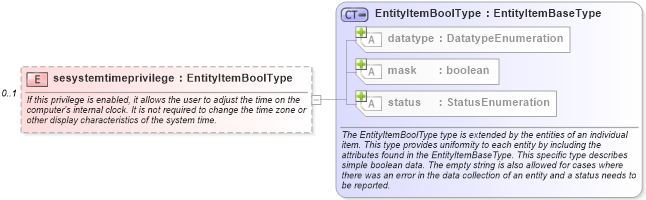
If this privilege is enabled, it allows the user to adjust the time on the computer's internal clock. It is not required to change the time zone or other display characteristics of the system time.
Collapse XSD Schema Diagram:
Drilldown into status in schema oval-system-characteristics-schema_xsd Drilldown into mask in schema oval-system-characteristics-schema_xsd Drilldown into datatype in schema oval-system-characteristics-schema_xsd Drilldown into EntityItemBoolType in schema oval-system-characteristics-schema_xsdXSD Diagram of sesystemtimeprivilege in schema windows-system-characteristics-schema_xsd (Open Vulnerability and Assessment Language (OVAL®))
Collapse XSD Schema Code:
<xsd:element name="sesystemtimeprivilege" type="oval-sc:EntityItemBoolType" minOccurs="0" maxOccurs="1">
    <xsd:annotation>
        <xsd:documentation>If this privilege is enabled, it allows the user to adjust the time on the computer's internal clock. It is not required to change the time zone or other display characteristics of the system time.</xsd:documentation>
        <xsd:appinfo>
            <sch:pattern id="atitemsesystemtimeprivilege" xmlns:sch="http://purl.oclc.org/dsdl/schematron">
                <sch:rule context="win-sc:accesstoken_item/win-sc:sesystemtimeprivilege">
                    <sch:assert test="@datatype='boolean'">item <sch:value-of select="../@id" /> - datatype attribute for the sesystemtimeprivilege entity of an accesstoken_item should be 'boolean'</sch:assert>
                </sch:rule>
            </sch:pattern>
        </xsd:appinfo>
    </xsd:annotation>
</xsd:element>
Collapse Child Attributes:
Name Type Default Value Use
datatype oval-sc:datatype string Optional
mask oval-sc:mask false Optional
status oval-sc:status exists Optional
Collapse Derivation Tree: