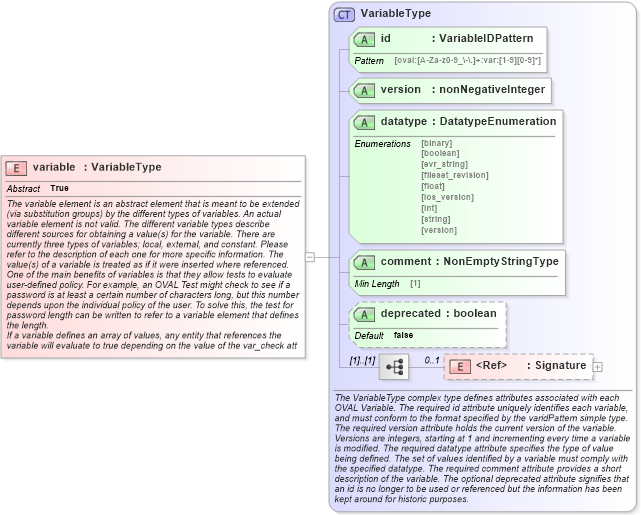
<xsd:element name="variable" type="oval-def:VariableType" abstract="true">
    <xsd:annotation>
        <xsd:documentation>The variable element is an abstract element that is meant to be extended (via substitution groups) by the different types of variables. An actual variable element is not valid. The different variable types describe different sources for obtaining a value(s) for the variable. There are currently three types of variables; local, external, and constant. Please refer to the description of each one for more specific information. The value(s) of a variable is treated as if it were inserted where referenced. One of the main benefits of variables is that they allow tests to evaluate user-defined policy. For example, an OVAL Test might check to see if a password is at least a certain number of characters long, but this number depends upon the individual policy of the user. To solve this, the test for password length can be written to refer to a variable element that defines the length.</xsd:documentation>
        <xsd:documentation>If a variable defines an array of values, any entity that references the variable will evaluate to true depending on the value of the var_check attribute. For example, if an entity 'size' with an operation of 'less than' references a variable that returns five different integers, and the var_check attribute has a value of 'all', then the 'size' entity returns true only if the actual size is less than each of the five integers defined by the variable. If a variable does not return any value, then an error should be thrown during OVAL analysis.</xsd:documentation>
    </xsd:annotation>
</xsd:element>
|
 XSD Schema Diagram: