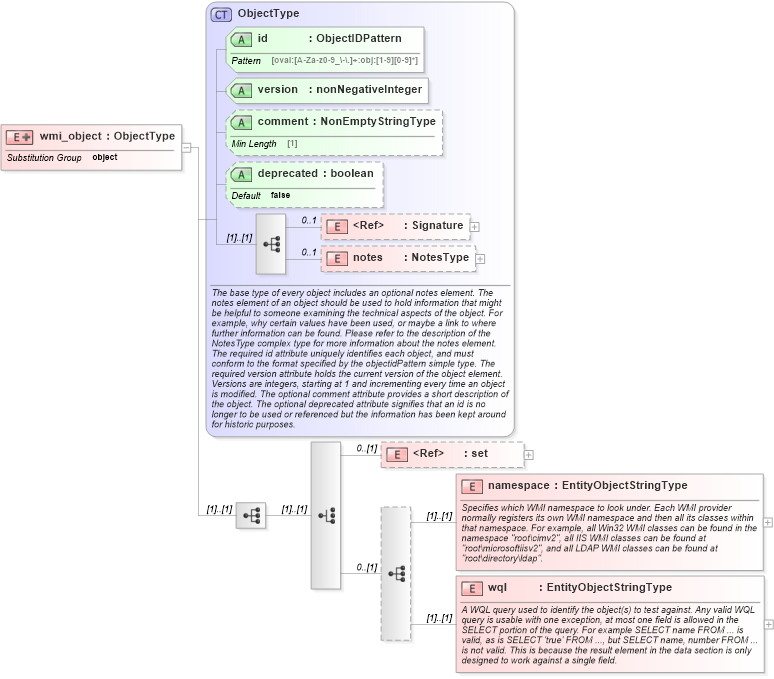
<xsd:element name="wmi_object" substitutionGroup="oval-def:object">
    <xsd:annotation>
        <xsd:documentation />
    </xsd:annotation>
    <xsd:complexType>
        <xsd:complexContent>
            <xsd:extension base="oval-def:ObjectType">
                <xsd:sequence>
                    <xsd:choice>
                        <xsd:element ref="oval-def:set" minOccurs="0" />
                        <xsd:sequence minOccurs="0">
                            <xsd:element name="namespace" type="oval-def:EntityObjectStringType">
                                <xsd:annotation>
                                    <xsd:documentation>Specifies which WMI namespace to look under. Each WMI provider normally registers its own WMI namespace and then all its classes within that namespace. For example, all Win32 WMI classes can be found in the namespace "root\cimv2", all IIS WMI classes can be found at "root\microsoftiisv2", and all LDAP WMI classes can be found at "root\directory\ldap".</xsd:documentation>
                                    <xsd:appinfo>
                                        <sch:pattern id="wmiobjnamespace" xmlns:sch="http://purl.oclc.org/dsdl/schematron">
                                            <sch:rule context="win-def:wmi_object/win-def:namespace">
                                                <sch:assert test="not(@datatype) or @datatype='string'">
                                                    <sch:value-of select="../@id" /> - datatype attribute for the namespace entity of a wmi_object should be 'string'</sch:assert>
                                            </sch:rule>
                                        </sch:pattern>
                                    </xsd:appinfo>
                                </xsd:annotation>
                            </xsd:element>
                            <xsd:element name="wql" type="oval-def:EntityObjectStringType">
                                <xsd:annotation>
                                    <xsd:documentation>A WQL query used to identify the object(s) to test against. Any valid WQL query is usable with one exception, at most one field is allowed in the SELECT portion of the query. For example SELECT name FROM ... is valid, as is SELECT 'true' FROM ..., but SELECT name, number FROM ... is not valid. This is because the result element in the data section is only designed to work against a single field.</xsd:documentation>
                                    <xsd:appinfo>
                                        <sch:pattern id="wmiobjwql" xmlns:sch="http://purl.oclc.org/dsdl/schematron">
                                            <sch:rule context="win-def:wmi_object/win-def:wql">
                                                <sch:assert test="not(@datatype) or @datatype='string'">
                                                    <sch:value-of select="../@id" /> - datatype attribute for the wql entity of a wmi_object should be 'string'</sch:assert>
                                            </sch:rule>
                                        </sch:pattern>
                                    </xsd:appinfo>
                                </xsd:annotation>
                            </xsd:element>
                        </xsd:sequence>
                    </xsd:choice>
                </xsd:sequence>
            </xsd:extension>
        </xsd:complexContent>
    </xsd:complexType>
</xsd:element>
|
 XSD Schema Diagram: