<xs:attribute name="lang">
    <xs:annotation>
        <xs:documentation>
            <div>
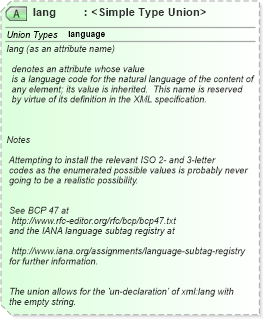
                <h3>lang (as an attribute name)</h3>
                <p>
       denotes an attribute whose value
       is a language code for the natural language of the content of
       any element; its value is inherited.  This name is reserved
       by virtue of its definition in the XML specification.</p>
            </div>
            <div>
                <h4>Notes</h4>
                <p>
      Attempting to install the relevant ISO 2- and 3-letter
      codes as the enumerated possible values is probably never
      going to be a realistic possibility.
     </p>
                <p>
      See BCP 47 at <a href="http://www.rfc-editor.org/rfc/bcp/bcp47.txt">
       http://www.rfc-editor.org/rfc/bcp/bcp47.txt</a>
      and the IANA language subtag registry at
      <a href="http://www.iana.org/assignments/language-subtag-registry">
       http://www.iana.org/assignments/language-subtag-registry</a>
      for further information.
     </p>
                <p>
      The union allows for the 'un-declaration' of xml:lang with
      the empty string.
     </p>
            </div>
        </xs:documentation>
    </xs:annotation>
    <xs:simpleType>
        <xs:union memberTypes="xs:language">
            <xs:simpleType>
                <xs:restriction base="xs:string">
                    <xs:enumeration value="" />
                </xs:restriction>
            </xs:simpleType>
        </xs:union>
    </xs:simpleType>
</xs:attribute>
|
 XSD Schema Diagram: