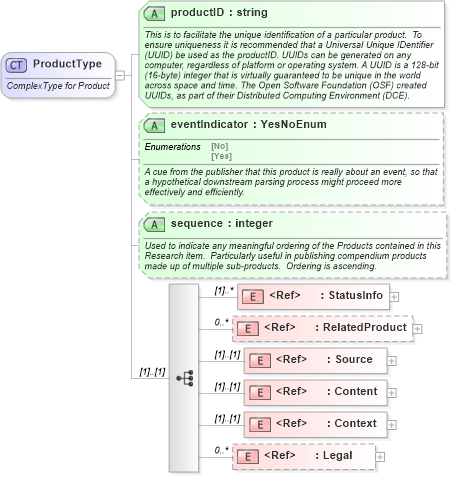
<xs:complexType name="ProductType">
    <xs:annotation>
        <xs:documentation>ComplexType for Product</xs:documentation>
    </xs:annotation>
    <xs:sequence>
        <xs:element ref="StatusInfo" maxOccurs="unbounded" />
        <xs:element ref="RelatedProduct" minOccurs="0" maxOccurs="unbounded" />
        <xs:element ref="Source" />
        <xs:element ref="Content" />
        <xs:element ref="Context" />
        <xs:element ref="Legal" minOccurs="0" maxOccurs="unbounded" />
    </xs:sequence>
    <xs:attribute name="productID" type="xs:string" use="required">
        <xs:annotation>
            <xs:documentation>This is to facilitate the unique identification of a particular product.  To ensure uniqueness it is recommended that a Universal Unique IDentifier (UUID) be used as the productID. UUIDs can be generated on any computer, regardless of platform or operating system. A UUID is a 128-bit (16-byte) integer that is virtually guaranteed to be unique in the world across space and time. The Open Software Foundation (OSF) created UUIDs, as part of their Distributed Computing Environment (DCE).</xs:documentation>
        </xs:annotation>
    </xs:attribute>
    <xs:attribute name="eventIndicator" type="rixmldt:YesNoEnum" use="optional">
        <xs:annotation>
            <xs:documentation>A cue from the publisher that this product is really about an event, so that a hypothetical downstream parsing process might proceed more effectively and efficiently.  </xs:documentation>
        </xs:annotation>
    </xs:attribute>
    <xs:attribute name="sequence" type="xs:integer" use="optional">
        <xs:annotation>
            <xs:documentation>Used to indicate any meaningful ordering of the Products contained in this Research item.  Particularly useful in publishing compendium products made up of multiple sub-products.  Ordering is ascending.  </xs:documentation>
        </xs:annotation>
    </xs:attribute>
</xs:complexType>
|
 XSD Schema Diagram: