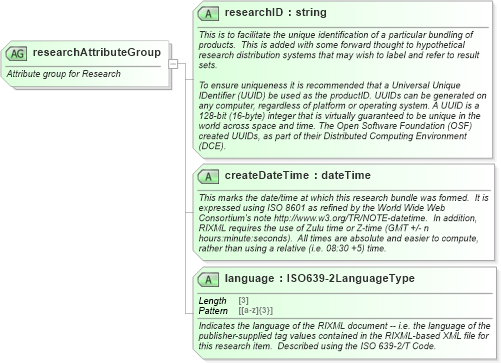
<xs:attributeGroup name="researchAttributeGroup">
    <xs:annotation>
        <xs:documentation>Attribute group for Research</xs:documentation>
    </xs:annotation>
    <xs:attribute name="researchID" type="xs:string" use="required">
        <xs:annotation>
            <xs:documentation>This is to facilitate the unique identification of a particular bundling of products.  This is added with some forward thought to hypothetical research distribution systems that may wish to label and refer to result sets.

To ensure uniqueness it is recommended that a Universal Unique IDentifier (UUID) be used as the productID. UUIDs can be generated on any computer, regardless of platform or operating system. A UUID is a 128-bit (16-byte) integer that is virtually guaranteed to be unique in the world across space and time. The Open Software Foundation (OSF) created UUIDs, as part of their Distributed Computing Environment (DCE).</xs:documentation>
        </xs:annotation>
    </xs:attribute>
    <xs:attribute name="createDateTime" type="xs:dateTime" use="required">
        <xs:annotation>
            <xs:documentation>This marks the date/time at which this research bundle was formed.  It is expressed using ISO 8601 as refined by the World Wide Web Consortium's note http://www.w3.org/TR/NOTE-datetime.  In addition, RIXML requires the use of Zulu time or Z-time (GMT +/- n hours:minute:seconds).  All times are absolute and easier to compute, rather than using a relative (i.e. 08:30 +5) time.  </xs:documentation>
        </xs:annotation>
    </xs:attribute>
    <xs:attribute name="language" type="rixmldt:ISO639-2LanguageType" use="required">
        <xs:annotation>
            <xs:documentation>Indicates the language of the RIXML document -- i.e. the language of the publisher-supplied tag values contained in the RIXML-based XML file for this research item.  Described using the ISO 639-2/T Code. </xs:documentation>
        </xs:annotation>
    </xs:attribute>
</xs:attributeGroup>
|
 XSD Schema Diagram: