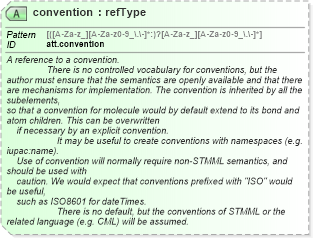
<xsd:attribute id="att.convention" name="convention" type="refType">
    <xsd:annotation>
        <xsd:documentation>
            <h:div class="summary" xmlns:h="http://www.w3.org/1999/xhtml">A reference to a convention.</h:div>
            <h:div class="description" xmlns:h="http://www.w3.org/1999/xhtml">There is no controlled vocabulary for conventions, but the author must ensure that the semantics are openly available and that there are mechanisms for implementation. The convention is inherited by all the subelements,
so that a convention for <h:tt>molecule</h:tt> would by default extend to its <h:tt>bond</h:tt> and <h:tt>atom</h:tt> children. This can be overwritten
    if necessary by an explicit <h:tt>convention</h:tt>.
                    <h:p>It may be useful to create conventions with namespaces (e.g. <h:tt>iupac:name</h:tt>).
    Use of <h:tt>convention</h:tt> will normally require non-STMML semantics, and should be used with
    caution. We would expect that conventions prefixed with "ISO" would be useful,
    such as ISO8601 for dateTimes.</h:p>
                <h:p>There is no default, but the conventions of STMML or the related language (e.g. CML) will be assumed.</h:p>
            </h:div>
            <h:div class="example" id="ex" href="convGroup1.xml" xmlns:h="http://www.w3.org/1999/xhtml" />
        </xsd:documentation>
    </xsd:annotation>
</xsd:attribute>
|
 XSD Schema Diagram: