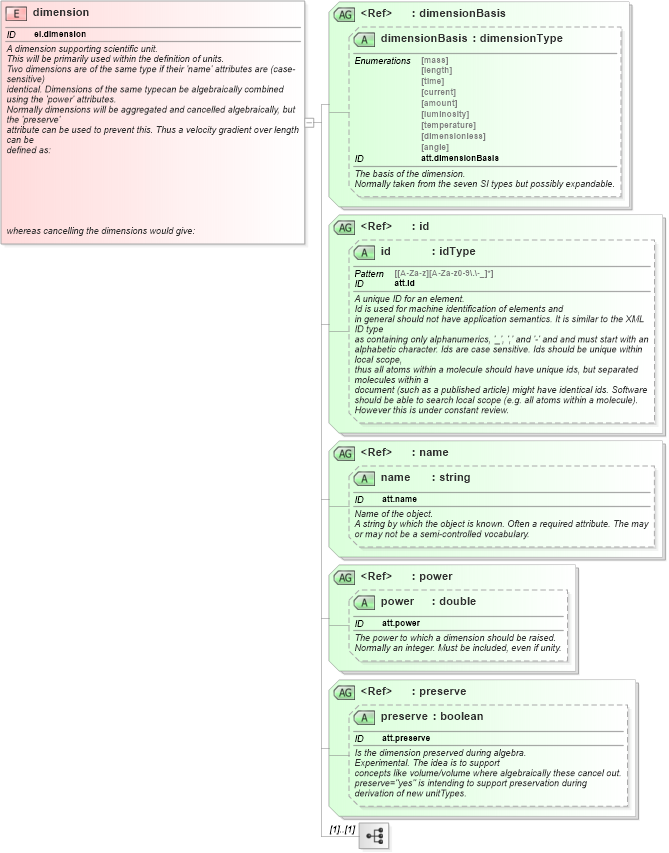
<xsd:element name="dimension" id="el.dimension">
    <xsd:annotation>
        <xsd:documentation>
            <h:div class="summary" xmlns:h="http://www.w3.org/1999/xhtml">A dimension supporting scientific unit.</h:div>
            <h:div class="description" xmlns:h="http://www.w3.org/1999/xhtml">This will be primarily used within the definition of units.
            Two dimensions are of the same type if their 'name' attributes are (case-sensitive)
            identical. Dimensions of the same typecan be algebraically combined using the 'power' attributes.
            Normally dimensions will be aggregated and cancelled algebraically, but the 'preserve'
            attribute can be used to prevent this. Thus a velocity gradient over length can be
            defined as:
            <h:pre><unitType id="a1" preserve="true" xmlns=""><dimension name="length" power="1" /><dimension name="time" power="-1" /><dimension name="length" power="-1" /></unitType></h:pre>
            whereas cancelling the dimensions would give:
            <h:pre><unitType id="a1" preserve="true" xmlns=""><dimension name="time" power="-1" /></unitType></h:pre></h:div>
            <h:div class="example" href="dimension1.xml" xmlns:h="http://www.w3.org/1999/xhtml" />
            <h:div class="example" href="dimension2.xml" xmlns:h="http://www.w3.org/1999/xhtml" />
        </xsd:documentation>
    </xsd:annotation>
    <xsd:complexType>
        <xsd:sequence />
        <xsd:attributeGroup ref="dimensionBasis" />
        <xsd:attributeGroup ref="id" />
        <xsd:attributeGroup ref="name" />
        <xsd:attributeGroup ref="power" />
        <xsd:attributeGroup ref="preserve" />
    </xsd:complexType>
</xsd:element>
|
 XSD Schema Diagram: