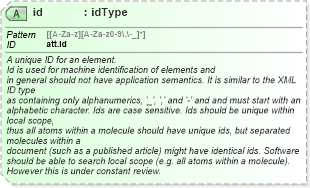
<xsd:attribute id="att.id" name="id" type="idType">
    <xsd:annotation>
        <xsd:documentation>
            <h:div class="summary" xmlns:h="http://www.w3.org/1999/xhtml">A unique ID for an element.</h:div>
            <h:div class="description" xmlns:h="http://www.w3.org/1999/xhtml">Id is used for machine identification of elements and
                in general should not have application semantics. It is similar to the XML ID type
                as containing only alphanumerics, '_', ',' and '-' and and must start with an
                alphabetic character. Ids are case sensitive. Ids should be unique within local scope,
                thus all atoms within a molecule should have unique ids, but separated molecules within a
                document (such as a published article) might have identical ids. Software
                should be able to search local scope (e.g. all atoms within a molecule).
                However this is under constant review.</h:div>
        </xsd:documentation>
    </xsd:annotation>
</xsd:attribute>
|
 XSD Schema Diagram: