<xsd:simpleType name="idType" id="st.idType">
    <xsd:annotation>
        <xsd:documentation>
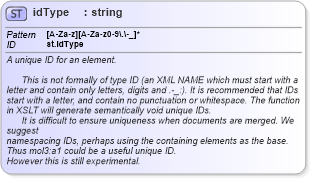
            <h:div class="summary" xmlns:h="http://www.w3.org/1999/xhtml">A unique ID for an element.</h:div>
            <h:div class="description" xmlns:h="http://www.w3.org/1999/xhtml">
                <h:p>This is not formally of type ID (an XML NAME which must start with a letter and contain only letters, digits and <h:tt>.-_:</h:tt>). It is recommended that IDs start with a letter, and contain no punctuation or whitespace. The function in XSLT will generate semantically void unique IDs.</h:p>
                <h:p>It is difficult to ensure uniqueness when documents are merged. We suggest
          namespacing IDs, perhaps using the containing elements as the base.
          Thus <h:tt>mol3:a1</h:tt> could be a useful unique ID.
          However this is still experimental.</h:p>
            </h:div>
        </xsd:documentation>
    </xsd:annotation>
    <!--    <xsd:restriction base="xsd:QName"/>-->
    <xsd:restriction base="xsd:string">
        <xsd:pattern value="[A-Za-z][A-Za-z0-9\.\-_]*" />
    </xsd:restriction>
</xsd:simpleType>
|
 XSD Schema Diagram:
 Facets: