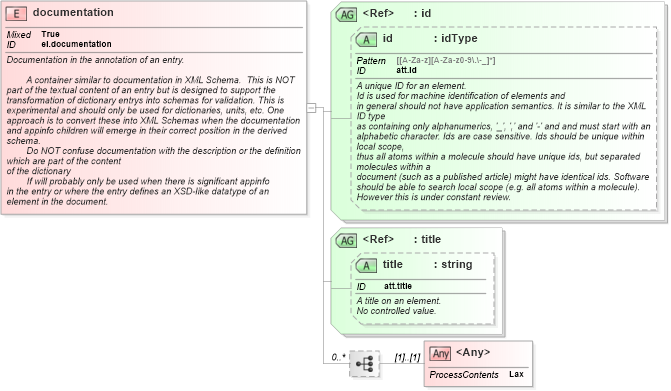
<xsd:element name="documentation" id="el.documentation">
    <xsd:annotation>
        <xsd:documentation>
            <h:div class="summary" xmlns:h="http://www.w3.org/1999/xhtml">Documentation in the annotation of an entry.</h:div>
            <h:div class="description" xmlns:h="http://www.w3.org/1999/xhtml">
                <h:p>A container similar to <h:tt>documentation</h:tt> in XML Schema.  This is NOT part of the textual content of an entry but is designed to support the transformation of dictionary entrys into schemas for validation. This is experimental and should only be used for dictionaries, units, etc. One approach is to convert these into XML Schemas when the <h:tt>documentation</h:tt> and <h:tt>appinfo</h:tt> children will emerge in their correct position in the derived schema.</h:p>
                <h:p>Do NOT confuse documentation with the description or the definition which are part of the content
        of the dictionary</h:p>
                <h:p>If will probably only be used when there is significant appinfo
        in the entry or where the entry defines an XSD-like datatype of an element in the document.</h:p>
            </h:div>
            <h:div class="example" href="documentation1.xml" xmlns:h="http://www.w3.org/1999/xhtml" />
        </xsd:documentation>
    </xsd:annotation>
    <xsd:complexType mixed="true">
        <xsd:sequence minOccurs="0" maxOccurs="unbounded">
            <xsd:any processContents="lax" />
        </xsd:sequence>
        <xsd:attributeGroup ref="id" />
        <xsd:attributeGroup ref="title" />
    </xsd:complexType>
</xsd:element>
|
 XSD Schema Diagram: