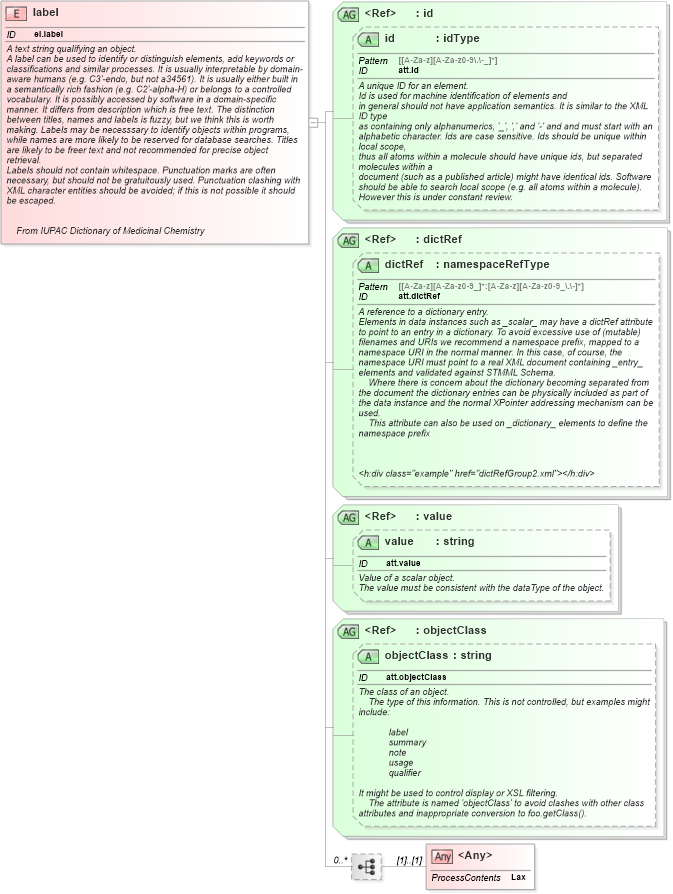
<xsd:element name="label" id="el.label">
    <xsd:annotation>
        <xsd:documentation>
            <h:div class="summary" xmlns:h="http://www.w3.org/1999/xhtml">A text string qualifying an object.</h:div>
            <h:div class="description" xmlns:h="http://www.w3.org/1999/xhtml">A label can be used to identify or distinguish elements, add keywords or classifications and similar processes. It is usually interpretable by domain-aware humans (e.g. C3'-endo, but not a34561). It is usually either built in a semantically rich fashion (e.g. C2'-alpha-H) or belongs to a controlled vocabulary. It is possibly accessed by software in a domain-specific manner. It differs from <h:tt>description</h:tt> which is free text. The distinction between titles, names and labels is fuzzy, but we think this is worth making. Labels may be necesssary to identify objects within programs, while names are more likely to be reserved for database searches. Titles are likely to be freer text and not recommended for precise object retrieval.</h:div>
            <h:div class="note" xmlns:h="http://www.w3.org/1999/xhtml">Labels should not contain whitespace. Punctuation marks are often necessary, but should not be gratuitously used. Punctuation clashing with XML character entities should be avoided; if this is not possible it should be escaped.</h:div>
            <h:div class="example" href="label1.xml" xmlns:h="http://www.w3.org/1999/xhtml">
                <h:em>From IUPAC Dictionary of Medicinal Chemistry</h:em>
            </h:div>
        </xsd:documentation>
    </xsd:annotation>
    <xsd:complexType>
        <xsd:sequence minOccurs="0" maxOccurs="unbounded">
            <xsd:any processContents="lax" />
        </xsd:sequence>
        <xsd:attributeGroup ref="id" />
        <xsd:attributeGroup ref="dictRef" />
        <xsd:attributeGroup ref="value" />
        <xsd:attributeGroup ref="objectClass" />
    </xsd:complexType>
</xsd:element>
|
 XSD Schema Diagram: