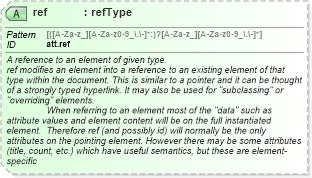
<xsd:attribute id="att.ref" name="ref" type="refType">
    <xsd:annotation>
        <xsd:documentation>
            <h:div class="summary" xmlns:h="http://www.w3.org/1999/xhtml">A reference to an element of given type.</h:div>
            <h:div class="description" xmlns:h="http://www.w3.org/1999/xhtml">
                <h:tt>ref</h:tt> modifies an element into a reference to an existing element of that type within the document. This is similar to a pointer and it can be thought of a strongly typed hyperlink. It may also be used for "subclassing" or "overriding" elements.<br xmlns="" />
								When referring to an element most of the "data" such as attribute values and element content will be on the full instantiated element.  Therefore ref (and possibly id) will normally be the only attributes on the pointing element. However there may be some attributes (title, count, etc.) which have useful semantics, but these are element-specific</h:div>
            <h:div class="example" href="refGroup1.xml" xmlns:h="http://www.w3.org/1999/xhtml" />
        </xsd:documentation>
    </xsd:annotation>
</xsd:attribute>
|
 XSD Schema Diagram: