Definition Type: Element
Name: paymentFrequency
Namespace: http://www.fpml.org/2003/FpML-4-0
Type: nsA:Interval
Containing Schema: fpml-ird-4-0.xsd
MinOccurs (1)
MaxOccurs (1)
Abstract
Documentation:
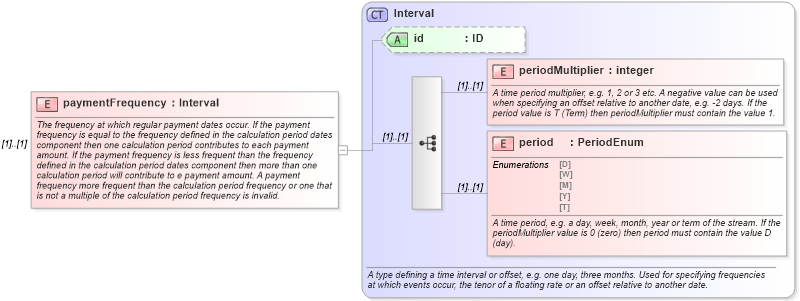
The frequency at which regular payment dates occur. If the payment frequency is equal to the frequency defined in the calculation period dates component then one calculation period contributes to each payment amount. If the payment frequency is less frequent than the frequency defined in the calculation period dates component then more than one calculation period will contribute to e payment amount. A payment frequency more frequent than the calculation period frequency or one that is not a multiple of the calculation period frequency is invalid.
Collapse XSD Schema Diagram:
Drilldown into period in schema fpml-shared-4-0_xsd Drilldown into periodMultiplier in schema fpml-shared-4-0_xsd Drilldown into id in schema fpml-shared-4-0_xsd Drilldown into Interval in schema fpml-shared-4-0_xsdXSD Diagram of paymentFrequency in schema fpml-ird-4-0_xsd (Financial products Markup Language (FpML®))
Collapse XSD Schema Code:
<xsd:element name="paymentFrequency" type="Interval">
    <xsd:annotation>
        <xsd:documentation xml:lang="en">The frequency at which regular payment dates occur. If the payment frequency is equal to the frequency defined in the calculation period dates component then one calculation period contributes to each payment amount. If the payment frequency is less frequent than the frequency defined in the calculation period dates component then more than one calculation period will contribute to e payment amount. A payment frequency more frequent than the calculation period frequency or one that is not a multiple of the calculation period frequency is invalid.</xsd:documentation>
    </xsd:annotation>
</xsd:element>
Collapse Child Elements:
Name Type Min Occurs Max Occurs
periodMultiplier nsA:periodMultiplier (1) (1)
period nsA:period (1) (1)
Collapse Child Attributes:
Name Type Default Value Use
id nsA:id (Optional)
Collapse Derivation Tree: