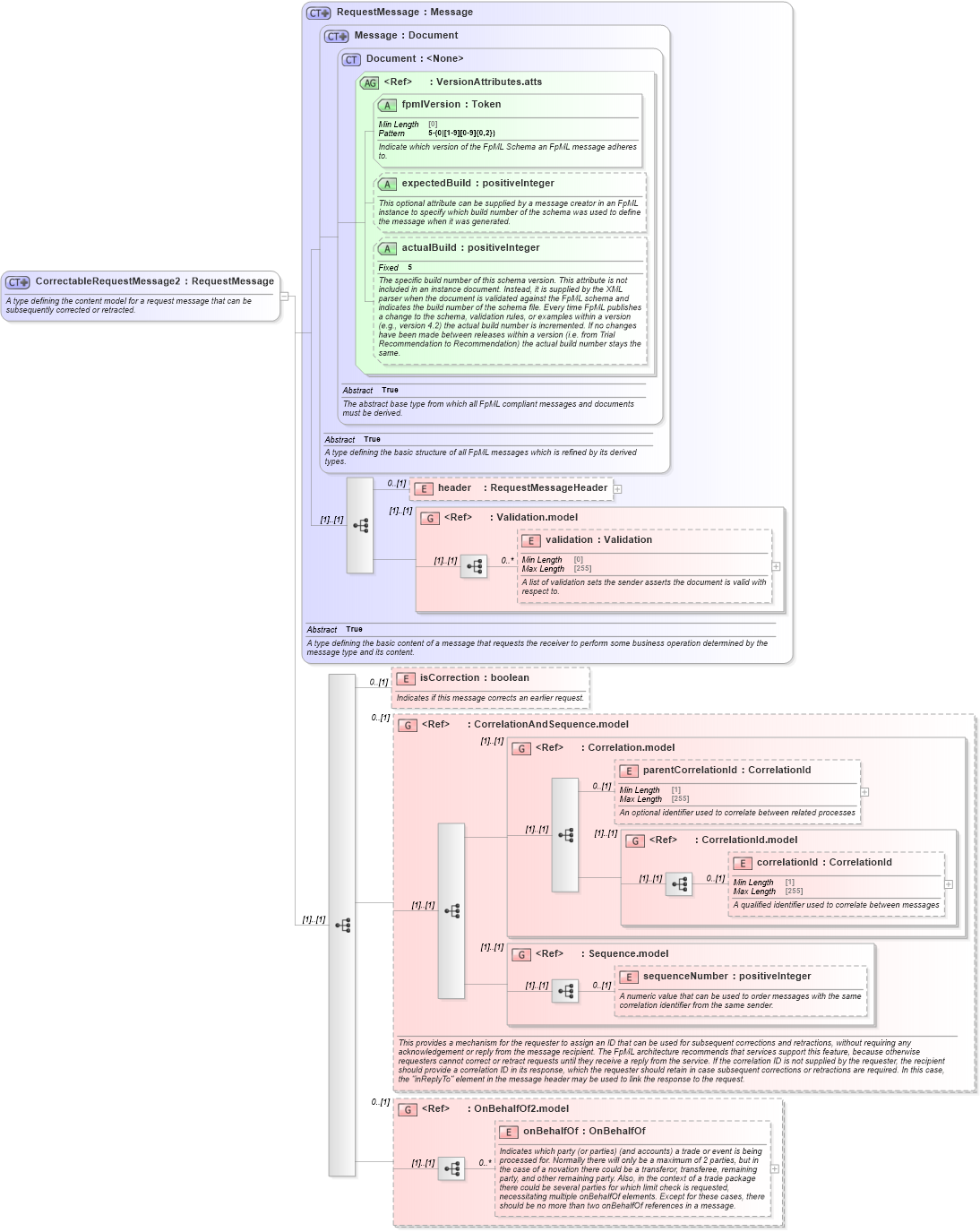
<xsd:complexType name="CorrectableRequestMessage2">
    <xsd:annotation>
        <xsd:documentation xml:lang="en">A type defining the content model for a request message that can be subsequently corrected or retracted.</xsd:documentation>
    </xsd:annotation>
    <xsd:complexContent>
        <xsd:extension base="RequestMessage">
            <xsd:sequence>
                <xsd:element name="isCorrection" type="xsd:boolean" minOccurs="0">
                    <xsd:annotation>
                        <xsd:documentation xml:lang="en">Indicates if this message corrects an earlier request.</xsd:documentation>
                    </xsd:annotation>
                </xsd:element>
                <xsd:group ref="CorrelationAndSequence.model" minOccurs="0">
                    <xsd:annotation>
                        <xsd:documentation xml:lang="en">This provides a mechanism for the requester to assign an ID that can be used for subsequent corrections and retractions, without requiring any acknowledgement or reply from the message recipient. The FpML architecture recommends that services support this feature, because otherwise requesters cannot correct or retract requests until they receive a reply from the service. If the correlation ID is not supplied by the requester, the recipient should provide a correlation ID in its response, which the requester should retain in case subsequent corrections or retractions are required. In this case, the "inReplyTo" element in the message header may be used to link the response to the request.</xsd:documentation>
                    </xsd:annotation>
                </xsd:group>
                <xsd:group ref="OnBehalfOf2.model" minOccurs="0" />
            </xsd:sequence>
        </xsd:extension>
    </xsd:complexContent>
</xsd:complexType>
|
 XSD Schema Diagram: