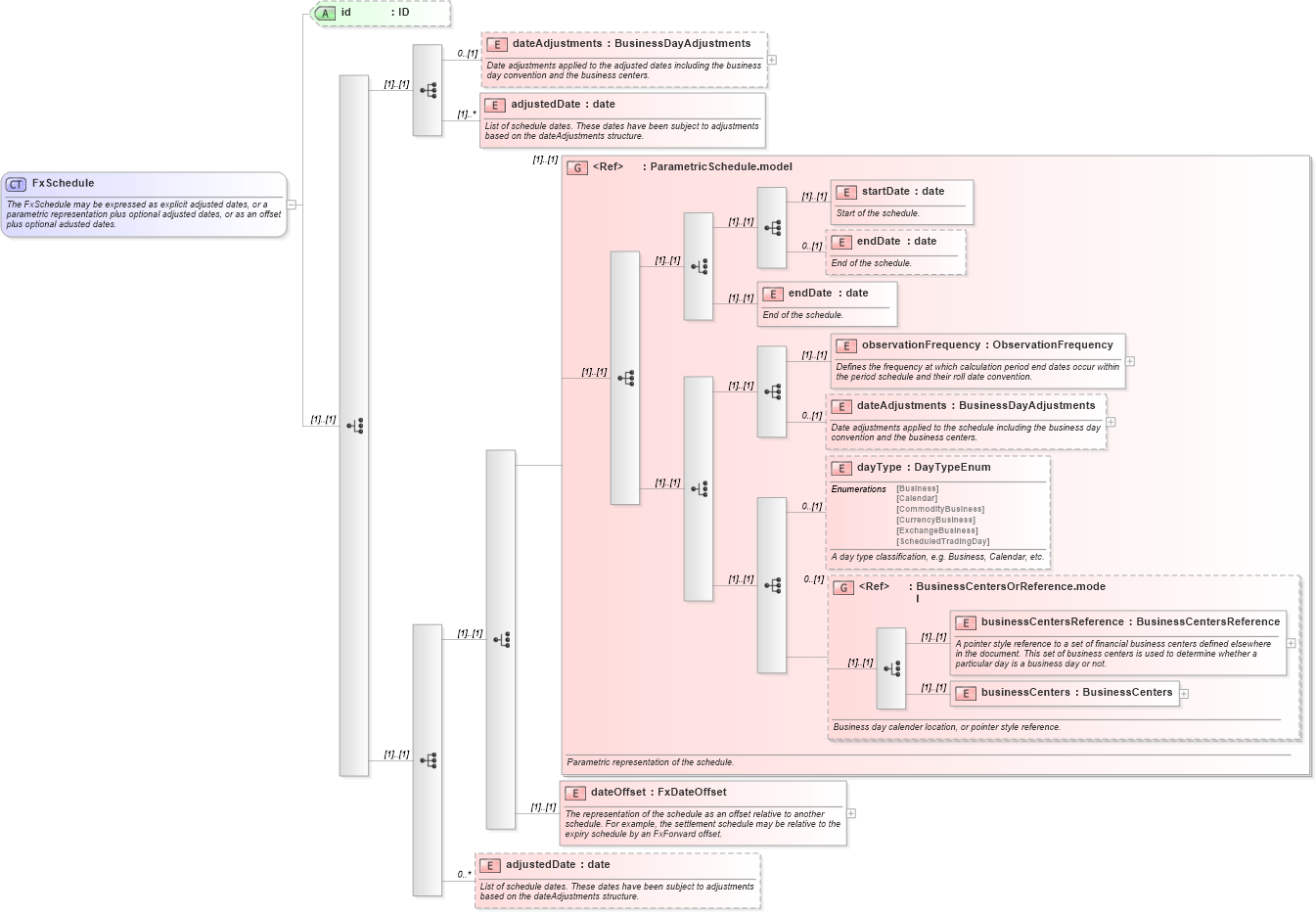
<xsd:complexType name="FxSchedule">
    <xsd:annotation>
        <xsd:documentation xml:lang="en">The FxSchedule may be expressed as explicit adjusted dates, or a parametric representation plus optional adjusted dates, or as an offset plus optional adusted dates.</xsd:documentation>
    </xsd:annotation>
    <xsd:choice>
        <xsd:sequence>
            <xsd:element name="dateAdjustments" type="BusinessDayAdjustments" minOccurs="0">
                <xsd:annotation>
                    <xsd:documentation xml:lang="en">Date adjustments applied to the adjusted dates including the business day convention and the business centers.</xsd:documentation>
                </xsd:annotation>
            </xsd:element>
            <xsd:element name="adjustedDate" type="xsd:date" maxOccurs="unbounded">
                <xsd:annotation>
                    <xsd:documentation xml:lang="en">List of schedule dates. These dates have been subject to adjustments based on the dateAdjustments structure.</xsd:documentation>
                </xsd:annotation>
            </xsd:element>
        </xsd:sequence>
        <xsd:sequence>
            <xsd:choice>
                <xsd:group ref="ParametricSchedule.model">
                    <xsd:annotation>
                        <xsd:documentation xml:lang="en">Parametric representation of the schedule.</xsd:documentation>
                    </xsd:annotation>
                </xsd:group>
                <xsd:element name="dateOffset" type="FxDateOffset">
                    <xsd:annotation>
                        <xsd:documentation xml:lang="en">The representation of the schedule as an offset relative to another schedule. For example, the settlement schedule may be relative to the expiry schedule by an FxForward offset.</xsd:documentation>
                    </xsd:annotation>
                </xsd:element>
            </xsd:choice>
            <xsd:element name="adjustedDate" type="xsd:date" minOccurs="0" maxOccurs="unbounded">
                <xsd:annotation>
                    <xsd:documentation xml:lang="en">List of schedule dates. These dates have been subject to adjustments based on the dateAdjustments structure.</xsd:documentation>
                </xsd:annotation>
            </xsd:element>
        </xsd:sequence>
    </xsd:choice>
    <xsd:attribute name="id" type="xsd:ID" />
</xsd:complexType>
|
 XSD Schema Diagram: