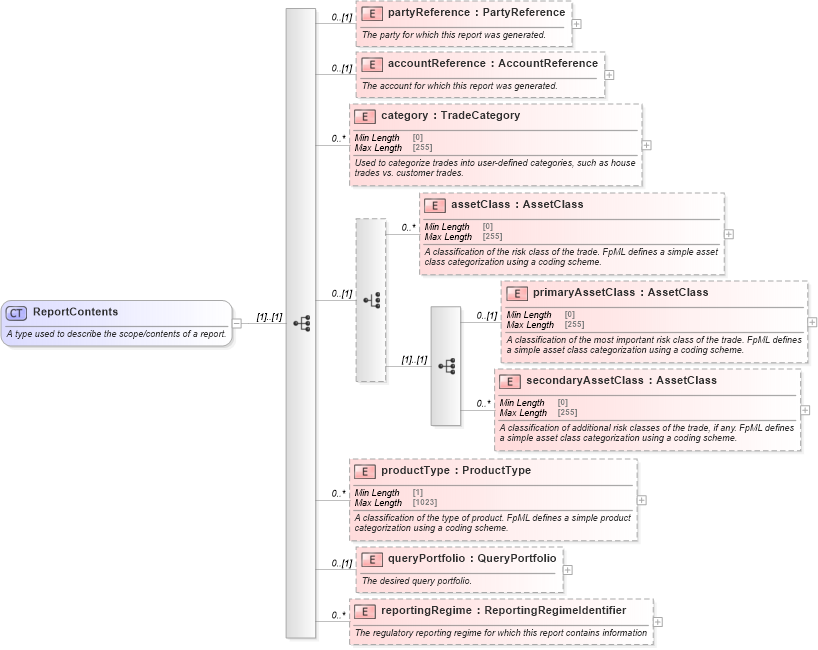
<xsd:complexType name="ReportContents">
    <xsd:annotation>
        <xsd:documentation xml:lang="en">A type used to describe the scope/contents of a report.</xsd:documentation>
    </xsd:annotation>
    <xsd:sequence>
        <xsd:element name="partyReference" type="PartyReference" minOccurs="0">
            <xsd:annotation>
                <xsd:documentation xml:lang="en">The party for which this report was generated.</xsd:documentation>
            </xsd:annotation>
        </xsd:element>
        <xsd:element name="accountReference" type="AccountReference" minOccurs="0">
            <xsd:annotation>
                <xsd:documentation xml:lang="en">The account for which this report was generated.</xsd:documentation>
            </xsd:annotation>
        </xsd:element>
        <xsd:element name="category" type="TradeCategory" minOccurs="0" maxOccurs="unbounded">
            <xsd:annotation>
                <xsd:documentation xml:lang="en">Used to categorize trades into user-defined categories, such as house trades vs. customer trades.</xsd:documentation>
            </xsd:annotation>
        </xsd:element>
        <xsd:choice minOccurs="0">
            <xsd:element name="assetClass" type="AssetClass" minOccurs="0" maxOccurs="unbounded">
                <xsd:annotation>
                    <xsd:documentation xml:lang="en">A classification of the risk class of the trade. FpML defines a simple asset class categorization using a coding scheme.</xsd:documentation>
                </xsd:annotation>
            </xsd:element>
            <xsd:sequence>
                <xsd:element name="primaryAssetClass" type="AssetClass" minOccurs="0">
                    <xsd:annotation>
                        <xsd:documentation xml:lang="en">A classification of the most important risk class of the trade. FpML defines a simple asset class categorization using a coding scheme.</xsd:documentation>
                    </xsd:annotation>
                </xsd:element>
                <xsd:element name="secondaryAssetClass" type="AssetClass" minOccurs="0" maxOccurs="unbounded">
                    <xsd:annotation>
                        <xsd:documentation xml:lang="en">A classification of additional risk classes of the trade, if any. FpML defines a simple asset class categorization using a coding scheme.</xsd:documentation>
                    </xsd:annotation>
                </xsd:element>
            </xsd:sequence>
        </xsd:choice>
        <xsd:element name="productType" type="ProductType" minOccurs="0" maxOccurs="unbounded">
            <xsd:annotation>
                <xsd:documentation xml:lang="en">A classification of the type of product. FpML defines a simple product categorization using a coding scheme.</xsd:documentation>
            </xsd:annotation>
        </xsd:element>
        <xsd:element name="queryPortfolio" type="QueryPortfolio" minOccurs="0">
            <xsd:annotation>
                <xsd:documentation xml:lang="en">The desired query portfolio.</xsd:documentation>
            </xsd:annotation>
        </xsd:element>
        <xsd:element name="reportingRegime" type="ReportingRegimeIdentifier" minOccurs="0" maxOccurs="unbounded">
            <xsd:annotation>
                <xsd:documentation xml:lang="en">The regulatory reporting regime for which this report contains information</xsd:documentation>
            </xsd:annotation>
        </xsd:element>
    </xsd:sequence>
</xsd:complexType>
|
 XSD Schema Diagram: