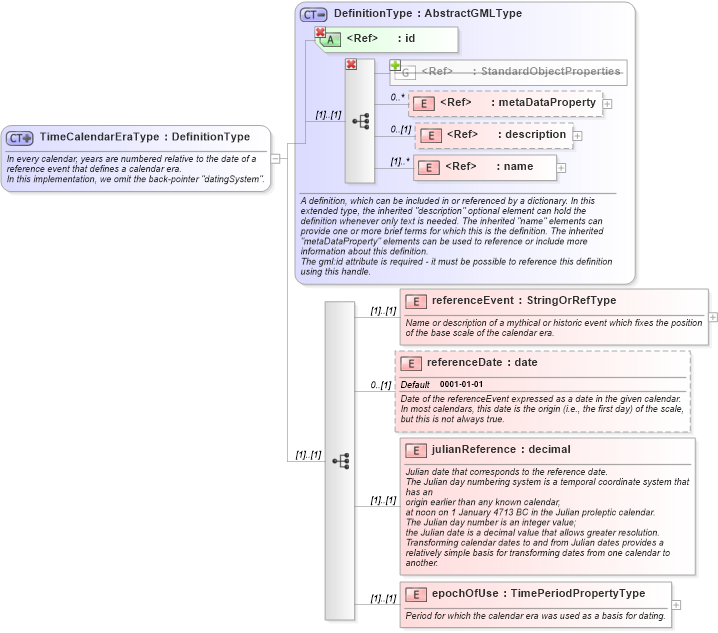
<complexType name="TimeCalendarEraType">
    <annotation>
        <documentation xml:lang="en">In every calendar, years are numbered relative to the date of a
      reference event that defines a calendar era.
      In this implementation, we omit the back-pointer "datingSystem".</documentation>
    </annotation>
    <complexContent>
        <extension base="gml:DefinitionType">
            <sequence>
                <element name="referenceEvent" type="gml:StringOrRefType">
                    <annotation>
                        <documentation>Name or description of a mythical or historic event which fixes the position of the base scale of the calendar era.</documentation>
                    </annotation>
                </element>
                <element name="referenceDate" type="date" default="0001-01-01" minOccurs="0">
                    <annotation>
                        <documentation>Date of the referenceEvent expressed as a date in the given calendar.
              In most calendars, this date is the origin (i.e., the first day) of the scale, but this is not always true.</documentation>
                    </annotation>
                </element>
                <element name="julianReference" type="decimal">
                    <annotation>
                        <documentation>Julian date that corresponds to the reference date.
              The Julian day numbering system is a temporal coordinate system that has an
              origin earlier than any known calendar,
              at noon on 1 January 4713 BC in the Julian proleptic calendar.
              The Julian day number is an integer value;
              the Julian date is a decimal value that allows greater resolution.
              Transforming calendar dates to and from Julian dates provides a
              relatively simple basis for transforming dates from one calendar to another.</documentation>
                    </annotation>
                </element>
                <element name="epochOfUse" type="gml:TimePeriodPropertyType">
                    <annotation>
                        <documentation>Period for which the calendar era was used as a basis for dating.</documentation>
                    </annotation>
                </element>
            </sequence>
        </extension>
    </complexContent>
</complexType>
|
 XSD Schema Diagram: