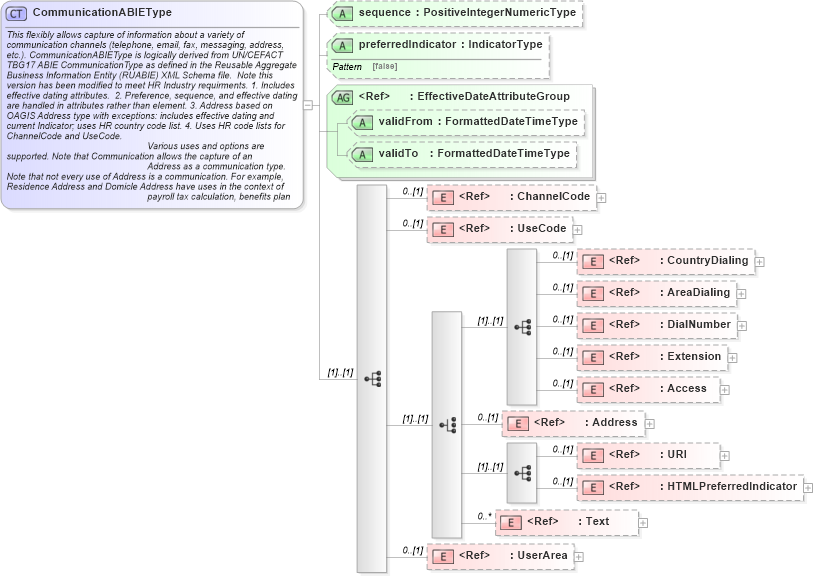
<xsd:complexType name="CommunicationABIEType">
    <xsd:annotation>
        <xsd:documentation>
            <ccts:DefinitionText xmlns:ccts="urn:un:unece:uncefact:documentation:1.1">This flexibly allows capture of information about a variety of communication channels (telephone, email, fax, messaging, address, etc.). CommunicationABIEType is logically derived from UN/CEFACT TBG17 ABIE CommunicationType as defined in the Reusable Aggregate Business Information Entity (RUABIE) XML Schema file.  Note this version has been modified to meet HR Industry requirments. 1. Includes effective dating attributes.  2. Preference, sequence, and effective dating are handled in attributes rather than element. 3. Address based on OAGIS Address type with exceptions: includes effective dating and current Indicator; uses HR country code list. 4. Uses HR code lists for ChannelCode and UseCode. </ccts:DefinitionText>
            <ccts:UsageRule xmlns:ccts="urn:un:unece:uncefact:documentation:1.1">Various uses and options are supported. Note that Communication allows the capture of an
				Address as a communication type. Note that not every use of Address is a communication. For example, Residence Address and Domicle Address have uses in the context of
				payroll tax calculation, benefits plan eligibility determination, and employment screening that are distinct from usage of an address as a communication means. IIn this case,
				the Address 'type' attribute would specify the address as Residence or Domicile.</ccts:UsageRule>
            <ccts:UsageRule xmlns:ccts="urn:un:unece:uncefact:documentation:1.1">Residence definition: The place of a person's general abode. A person's actual dwelling place in fact. This may be a temporary residence or a long-term residence. Residence Address is often a legal or official address for purposes of determinations such as work eligibility, applicable payroll taxes, and benefits program eligibility. This also is an address of
of importance to processes such as employment screening that make use of residence history to direct the scope of screenings that may be conducted. </ccts:UsageRule>
            <ccts:UsageRule xmlns:ccts="urn:un:unece:uncefact:documentation:1.1">Domicile definition: Black's Law Dictionary, Sixth Edition: "A person's legal home. That place where a man has his true, fixed, and permanent home and principal establishment, and to which whenever he is absent he has the intention of returning (emphasis added)(Smith v. Smith, 206 Pa. Super. 310).  A person may  have more than one residence but only one domicile.  The legal domicile of a person is important since it, rather than the actual residence, often controls the jurisdiction of the taxing authorities and determines where a person may exercise the privilege of voting and other legal rights and privileges."

OED:   Domicile n. 2. Law. The place where one has his home or permanent residence, to which, if absent, he has the intention of returning.

In some cases Domicile Address may be deterimined by, and have significance with repect to, determinations of applicable taxes or tax reportin.</ccts:UsageRule>
            <ccts:UsageRule xmlns:ccts="urn:un:unece:uncefact:documentation:1.1">Formatted telephone numbers should use the DialNumber element.</ccts:UsageRule>
        </xsd:documentation>
    </xsd:annotation>
    <xsd:sequence>
        <xsd:element ref="ChannelCode" minOccurs="0" />
        <xsd:element ref="UseCode" minOccurs="0" />
        <xsd:choice>
            <xsd:sequence>
                <xsd:element ref="oa:CountryDialing" minOccurs="0" />
                <xsd:element ref="oa:AreaDialing" minOccurs="0" />
                <xsd:element ref="oa:DialNumber" minOccurs="0" />
                <xsd:element ref="oa:Extension" minOccurs="0" />
                <xsd:element ref="oa:Access" minOccurs="0" />
            </xsd:sequence>
            <xsd:element ref="Address" minOccurs="0" />
            <xsd:sequence>
                <xsd:element ref="oa:URI" minOccurs="0" />
                <xsd:element ref="oa:HTMLPreferredIndicator" minOccurs="0" />
            </xsd:sequence>
            <xsd:element ref="oa:Text" minOccurs="0" maxOccurs="unbounded" />
        </xsd:choice>
        <xsd:element ref="UserArea" minOccurs="0" />
    </xsd:sequence>
    <xsd:attribute name="sequence" type="oa:PositiveIntegerNumericType" />
    <xsd:attribute name="preferredIndicator" type="oa:IndicatorType" />
    <xsd:attributeGroup ref="EffectiveDateAttributeGroup" />
</xsd:complexType>
|
 XSD Schema Diagram: