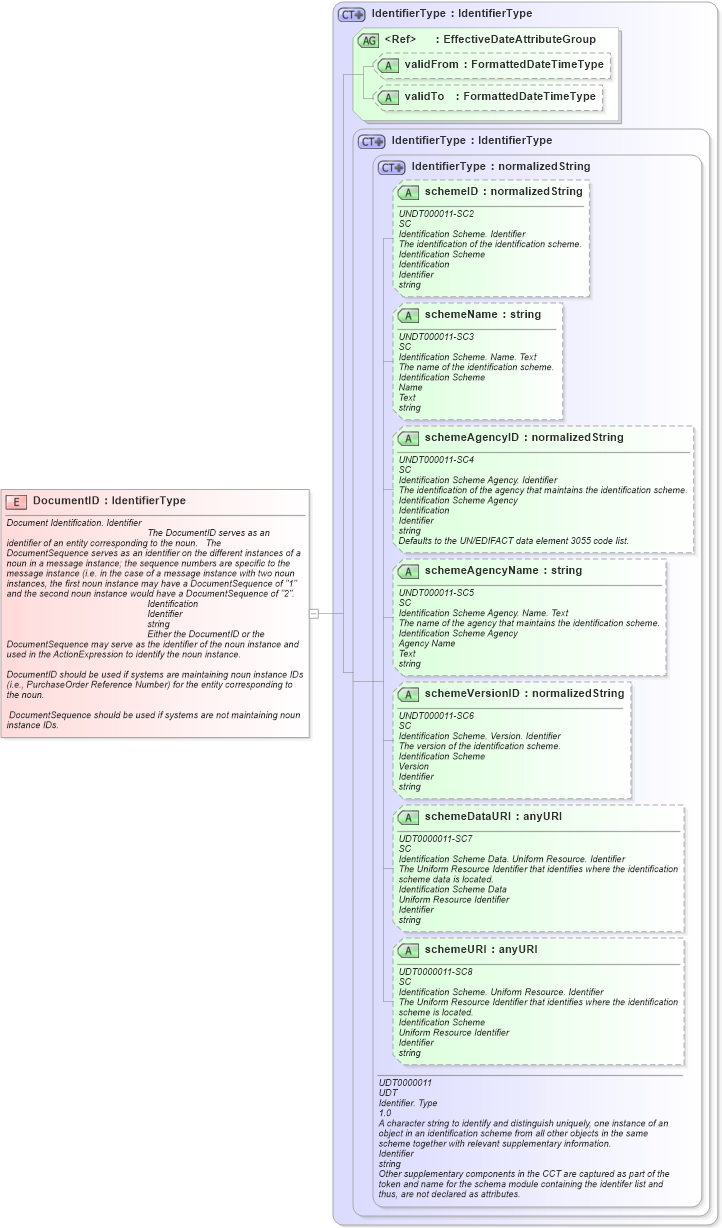
<xsd:element name="DocumentID" type="IdentifierType">
    <xsd:annotation>
        <xsd:documentation xml:lang="en">
            <ccts:DictionaryEntryName xmlns:ccts="urn:un:unece:uncefact:documentation:1.1">Document Identification. Identifier</ccts:DictionaryEntryName>
            <ccts:Definition xmlns:ccts="urn:un:unece:uncefact:documentation:1.1">The DocumentID serves as an identifier of an entity corresponding to the noun.   The DocumentSequence serves as an identifier on the different instances of a noun in a message instance; the sequence numbers are specific to the message instance (i.e. in the case of a message instance with two noun instances, the first noun instance may have a DocumentSequence of "1" and the second noun instance would have a DocumentSequence of "2".</ccts:Definition>
            <ccts:PropertyTermName xmlns:ccts="urn:un:unece:uncefact:documentation:1.1">Identification</ccts:PropertyTermName>
            <ccts:RepresentationTermName xmlns:ccts="urn:un:unece:uncefact:documentation:1.1">Identifier</ccts:RepresentationTermName>
            <ccts:PrimitiveType xmlns:ccts="urn:un:unece:uncefact:documentation:1.1">string</ccts:PrimitiveType>
            <ccts:UsageRule xmlns:ccts="urn:un:unece:uncefact:documentation:1.1">Either the DocumentID or the DocumentSequence may serve as the identifier of the noun instance and used in the ActionExpression to identify the noun instance.

DocumentID should be used if systems are maintaining noun instance IDs (i.e., PurchaseOrder Reference Number) for the entity corresponding to the noun.

 DocumentSequence should be used if systems are not maintaining noun instance IDs.
</ccts:UsageRule>
        </xsd:documentation>
    </xsd:annotation>
</xsd:element>
|
 XSD Schema Diagram: