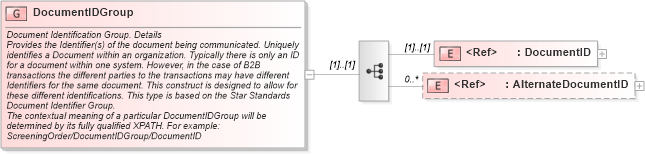
<xsd:group name="DocumentIDGroup">
    <xsd:annotation>
        <xsd:documentation source="http://www.hr-xml.org" xml:lang="en">
            <ccts:DictionaryEntryName xmlns:ccts="urn:un:unece:uncefact:documentation:1.1">Document Identification Group. Details</ccts:DictionaryEntryName>
            <ccts:DefinitionText xmlns:ccts="urn:un:unece:uncefact:documentation:1.1">Provides the Identifier(s) of the document being communicated. Uniquely identifies a Document within an organization. Typically there is only an ID for a document within one system. However, in the case of B2B transactions the different parties to the transactions may have different Identifiers for the same document. This construct is designed to allow for these different identifications. This type is based on the Star Standards Document Identifier Group. </ccts:DefinitionText>
            <ccts:UsageRule xmlns:ccts="urn:un:unece:uncefact:documentation:1.1">The contextual meaning of a particular DocumentIDGroup will be determined by its fully qualified XPATH. For example: ScreeningOrder/DocumentIDGroup/DocumentID</ccts:UsageRule>
        </xsd:documentation>
    </xsd:annotation>
    <xsd:sequence>
        <xsd:element ref="DocumentID" />
        <xsd:element ref="AlternateDocumentID" minOccurs="0" maxOccurs="unbounded" />
    </xsd:sequence>
</xsd:group>
|
 XSD Schema Diagram: