Definition Type: ComplexType
Name: ScreeningCatalogOrderType
Namespace: http://www.hr-xml.org/3
Containing Schema: ScreeningCatalogOrder.xsd
Abstract
Documentation:
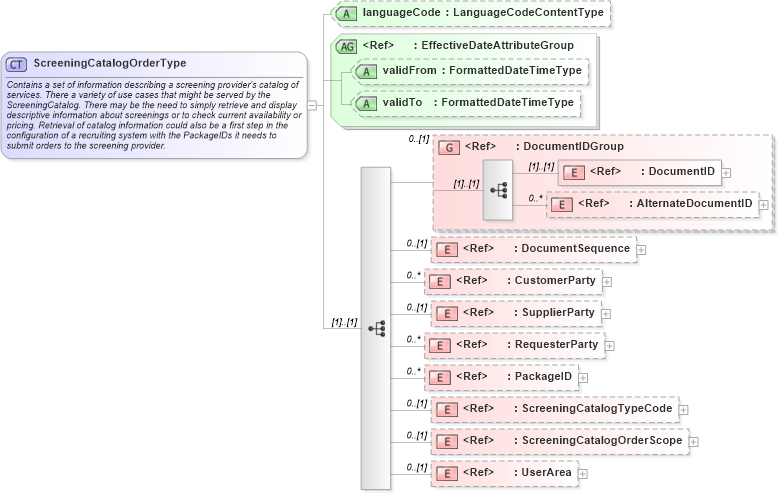
Contains a set of information describing a screening provider's catalog of services. There a variety of use cases that might be served by the ScreeningCatalog. There may be the need to simply retrieve and display descriptive information about screenings or to check current availability or pricing. Retrieval of catalog information could also be a first step in the configuration of a recruiting system with the PackageIDs it needs to submit orders to the screening provider.
Collapse XSD Schema Diagram:
Drilldown into UserArea in schema fields_xsd Drilldown into ScreeningCatalogOrderScope in schema components_xsd Drilldown into ScreeningCatalogTypeCode in schema fields_xsd Drilldown into PackageID in schema fields_xsd Drilldown into RequesterParty in schema components_xsd Drilldown into SupplierParty in schema components_xsd Drilldown into CustomerParty in schema components_xsd Drilldown into DocumentSequence in schema fields_xsd Drilldown into AlternateDocumentID in schema fields_xsd Drilldown into DocumentID in schema fields_xsd Drilldown into DocumentIDGroup in schema components_xsd Drilldown into validTo in schema fields_xsd Drilldown into validFrom in schema fields_xsd Drilldown into EffectiveDateAttributeGroup in schema fields_xsd Drilldown into languageCode in schema screeningcatalogorder_xsdXSD Diagram of ScreeningCatalogOrderType in schema screeningcatalogorder_xsd (HR-XML - Human Resources XML)
Collapse XSD Schema Code:
<xsd:complexType name="ScreeningCatalogOrderType">
    <xsd:annotation>
        <xsd:documentation>Contains a set of information describing a screening provider's catalog of services. There a variety of use cases that might be served by the ScreeningCatalog. There may be the need to simply retrieve and display descriptive information about screenings or to check current availability or pricing. Retrieval of catalog information could also be a first step in the configuration of a recruiting system with the PackageIDs it needs to submit orders to the screening provider.</xsd:documentation>
    </xsd:annotation>
    <xsd:sequence>
        <xsd:group ref="DocumentIDGroup" minOccurs="0" />
        <xsd:element ref="DocumentSequence" minOccurs="0" />
        <xsd:element ref="CustomerParty" minOccurs="0" maxOccurs="unbounded" />
        <xsd:element ref="SupplierParty" minOccurs="0" />
        <xsd:element ref="RequesterParty" minOccurs="0" maxOccurs="unbounded" />
        <xsd:element ref="PackageID" minOccurs="0" maxOccurs="unbounded" />
        <xsd:element ref="ScreeningCatalogTypeCode" minOccurs="0" />
        <xsd:element ref="ScreeningCatalogOrderScope" minOccurs="0" />
        <xsd:element ref="UserArea" minOccurs="0" />
    </xsd:sequence>
    <xsd:attribute name="languageCode" type="LanguageCodeContentType" use="optional" />
    <xsd:attributeGroup ref="EffectiveDateAttributeGroup" />
</xsd:complexType>
Collapse Child Elements:
Name Type Min Occurs Max Occurs
DocumentID nsA:DocumentID (1) (1)
AlternateDocumentID nsA:AlternateDocumentID 0 unbounded
DocumentSequence nsA:DocumentSequence 0 (1)
CustomerParty nsA:CustomerParty 0 unbounded
SupplierParty nsA:SupplierParty 0 (1)
RequesterParty nsA:RequesterParty 0 unbounded
PackageID nsA:PackageID 0 unbounded
ScreeningCatalogTypeCode nsA:ScreeningCatalogTypeCode 0 (1)
ScreeningCatalogOrderScope nsA:ScreeningCatalogOrderScope 0 (1)
UserArea nsA:UserArea 0 (1)
<xs:group> nsA:DocumentIDGroup 0 (1)
Collapse Child Attributes:
Name Type Default Value Use
languageCode nsA:languageCode Optional
validFrom nsA:validFrom Optional
validTo nsA:validTo Optional
Collapse Derivation Tree:
Collapse References:
nsA:ScreeningCatalogOrder