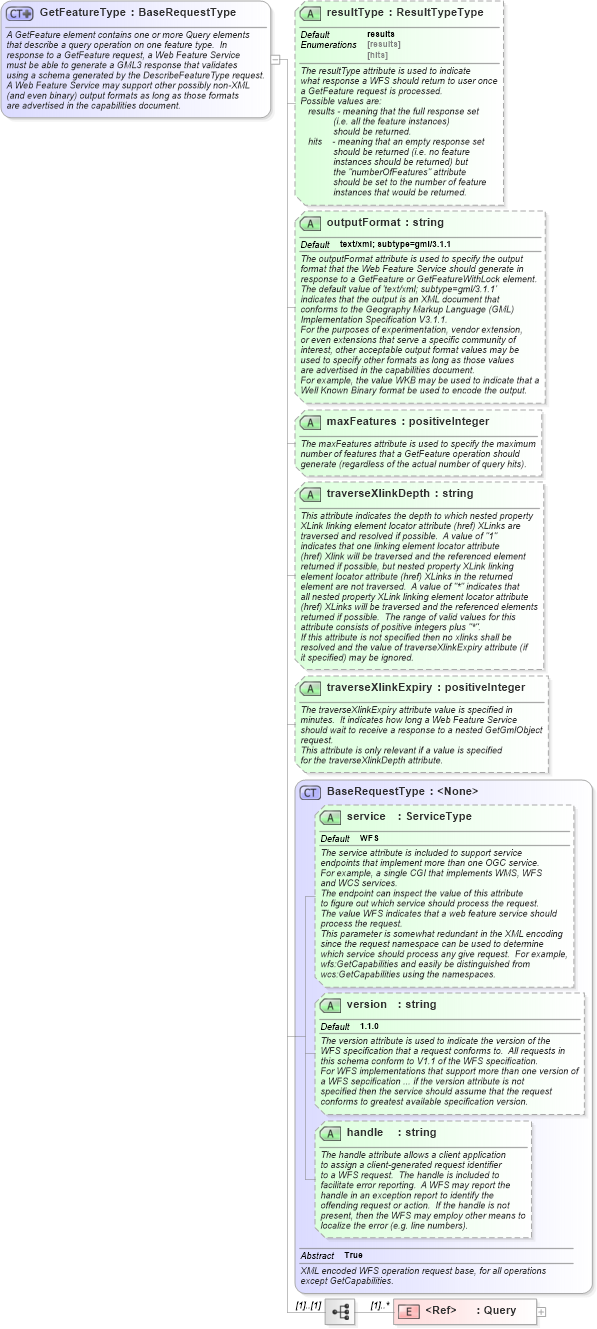
<xsd:complexType name="GetFeatureType">
    <xsd:annotation>
        <xsd:documentation>
            A GetFeature element contains one or more Query elements
            that describe a query operation on one feature type.  In
            response to a GetFeature request, a Web Feature Service
            must be able to generate a GML3 response that validates
            using a schema generated by the DescribeFeatureType request.
            A Web Feature Service may support other possibly non-XML
            (and even binary) output formats as long as those formats
            are advertised in the capabilities document.
         </xsd:documentation>
    </xsd:annotation>
    <xsd:complexContent>
        <xsd:extension base="wfs:BaseRequestType">
            <xsd:sequence>
                <xsd:element ref="wfs:Query" maxOccurs="unbounded" />
            </xsd:sequence>
            <xsd:attribute name="resultType" type="wfs:ResultTypeType" use="optional" default="results">
                <xsd:annotation>
                    <xsd:documentation>
                     The resultType attribute is used to indicate
                     what response a WFS should return to user once
                     a GetFeature request is processed.
                     Possible values are:
                        results - meaning that the full response set
                                  (i.e. all the feature instances)
                                  should be returned.
                        hits    - meaning that an empty response set
                                  should be returned (i.e. no feature
                                  instances should be returned) but
                                  the "numberOfFeatures" attribute
                                  should be set to the number of feature
                                  instances that would be returned.
                  </xsd:documentation>
                </xsd:annotation>
            </xsd:attribute>
            <xsd:attribute name="outputFormat" type="xsd:string" use="optional" default="text/xml; subtype=gml/3.1.1">
                <xsd:annotation>
                    <xsd:documentation>
                     The outputFormat attribute is used to specify the output
                     format that the Web Feature Service should generate in
                     response to a GetFeature or GetFeatureWithLock element.
                     The default value of 'text/xml; subtype=gml/3.1.1'
                     indicates that the output is an XML document that
                     conforms to the Geography Markup Language (GML)
                     Implementation Specification V3.1.1.
                     For the purposes of experimentation, vendor extension,
                     or even extensions that serve a specific community of
                     interest, other acceptable output format values may be
                     used to specify other formats as long as those values
                     are advertised in the capabilities document.
                     For example, the value WKB may be used to indicate that a
                     Well Known Binary format be used to encode the output.
                  </xsd:documentation>
                </xsd:annotation>
            </xsd:attribute>
            <xsd:attribute name="maxFeatures" type="xsd:positiveInteger" use="optional">
                <xsd:annotation>
                    <xsd:documentation>
                     The maxFeatures attribute is used to specify the maximum
                     number of features that a GetFeature operation should
                     generate (regardless of the actual number of query hits).
                  </xsd:documentation>
                </xsd:annotation>
            </xsd:attribute>
            <xsd:attribute name="traverseXlinkDepth" type="xsd:string" use="optional">
                <xsd:annotation>
                    <xsd:documentation>
                     This attribute indicates the depth to which nested property
                     XLink linking element locator attribute (href) XLinks are
                     traversed and resolved if possible.  A value of "1"
                     indicates that one linking element locator attribute
                     (href) Xlink will be traversed and the referenced element
                     returned if possible, but nested property XLink linking
                     element locator attribute (href) XLinks in the returned
                     element are not traversed.  A value of "*" indicates that
                     all nested property XLink linking element locator attribute
                     (href) XLinks will be traversed and the referenced elements
                     returned if possible.  The range of valid values for this
                     attribute consists of positive integers plus "*".
                     If this attribute is not specified then no xlinks shall be
                     resolved and the value of traverseXlinkExpiry attribute (if
                     it specified) may be ignored.
                  </xsd:documentation>
                </xsd:annotation>
            </xsd:attribute>
            <xsd:attribute name="traverseXlinkExpiry" type="xsd:positiveInteger" use="optional">
                <xsd:annotation>
                    <xsd:documentation>
                     The traverseXlinkExpiry attribute value is specified in
                     minutes.  It indicates how long a Web Feature Service
                     should wait to receive a response to a nested GetGmlObject
                     request.
                     This attribute is only relevant if a value is specified
                     for the traverseXlinkDepth attribute.
                  </xsd:documentation>
                </xsd:annotation>
            </xsd:attribute>
        </xsd:extension>
    </xsd:complexContent>
</xsd:complexType>
|
 XSD Schema Diagram: