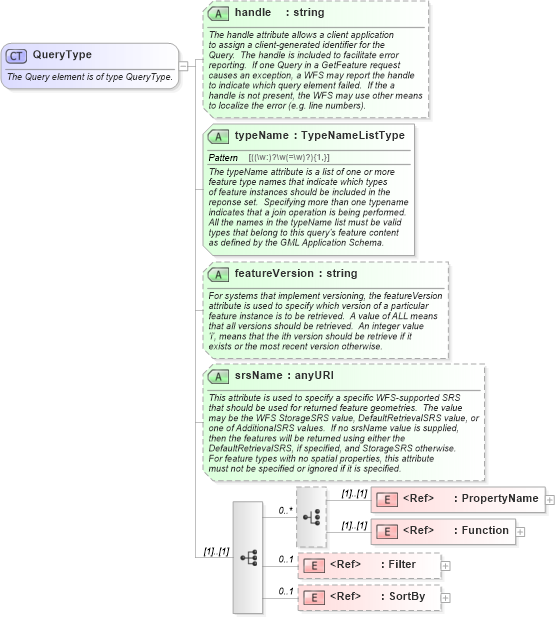
<xsd:complexType name="QueryType">
    <xsd:annotation>
        <xsd:documentation>
            The Query element is of type QueryType.
         </xsd:documentation>
    </xsd:annotation>
    <xsd:sequence>
        <xsd:choice minOccurs="0" maxOccurs="unbounded">
            <xsd:element ref="wfs:PropertyName">
                <xsd:annotation>
                    <xsd:documentation>
                   The Property element is used to specify one or more
                   properties of a feature whose values are to be retrieved
                   by a Web Feature Service.

                   While a Web Feature Service should endeavour to satisfy
                   the exact request specified, in some instance this may
                   not be possible.  Specifically, a Web Feature Service
                   must generate a valid GML3 response to a Query operation.
                   The schema used to generate the output may include
                   properties that are mandatory.  In order that the output
                   validates, these mandatory properties must be specified
                   in the request.  If they are not, a Web Feature Service
                   may add them automatically to the Query before processing
                   it.  Thus a client application should, in general, be
                   prepared to receive more properties than it requested.

                   Of course, using the DescribeFeatureType request, a client
                   application can determine which properties are mandatory
                   and request them in the first place.
                </xsd:documentation>
                </xsd:annotation>
            </xsd:element>
            <xsd:element ref="ogc:Function">
                <xsd:annotation>
                    <xsd:documentation>
                   A function may be used as a select item in a query.
                   However, if a function is used, care must be taken
                   to ensure that the result type matches the type in the

                </xsd:documentation>
                </xsd:annotation>
            </xsd:element>
        </xsd:choice>
        <xsd:element ref="ogc:Filter" minOccurs="0" maxOccurs="1">
            <xsd:annotation>
                <xsd:documentation>
                The Filter element is used to define spatial and/or non-spatial
                constraints on query.  Spatial constrains use GML3 to specify
                the constraining geometry.  A full description of the Filter
                element can be found in the Filter Encoding Implementation
                Specification.
             </xsd:documentation>
            </xsd:annotation>
        </xsd:element>
        <xsd:element ref="ogc:SortBy" minOccurs="0" maxOccurs="1">
            <xsd:annotation>
                <xsd:documentation>
                The SortBy element is used specify property names whose
                values should be used to order (upon presentation) the
                set of feature instances that satisfy the query.
             </xsd:documentation>
            </xsd:annotation>
        </xsd:element>
    </xsd:sequence>
    <xsd:attribute name="handle" type="xsd:string" use="optional">
        <xsd:annotation>
            <xsd:documentation>
               The handle attribute allows a client application
               to assign a client-generated identifier for the
               Query.  The handle is included to facilitate error
               reporting.  If one Query in a GetFeature request
               causes an exception, a WFS may report the handle
               to indicate which query element failed.  If the a
               handle is not present, the WFS may use other means
               to localize the error (e.g. line numbers).
            </xsd:documentation>
        </xsd:annotation>
    </xsd:attribute>
    <xsd:attribute name="typeName" type="wfs:TypeNameListType" use="required">
        <xsd:annotation>
            <xsd:documentation>
              The typeName attribute is a list of one or more
              feature type names that indicate which types
              of feature instances should be included in the
              reponse set.  Specifying more than one typename
              indicates that a join operation is being performed.
              All the names in the typeName list must be valid
              types that belong to this query's feature content
              as defined by the GML Application Schema.
           </xsd:documentation>
        </xsd:annotation>
    </xsd:attribute>
    <xsd:attribute name="featureVersion" type="xsd:string" use="optional">
        <xsd:annotation>
            <xsd:documentation>
              For systems that implement versioning, the featureVersion
              attribute is used to specify which version of a particular
              feature instance is to be retrieved.  A value of ALL means
              that all versions should be retrieved.  An integer value
              'i', means that the ith version should be retrieve if it
              exists or the most recent version otherwise.
           </xsd:documentation>
        </xsd:annotation>
    </xsd:attribute>
    <xsd:attribute name="srsName" type="xsd:anyURI" use="optional">
        <xsd:annotation>
            <xsd:documentation>
              This attribute is used to specify a specific WFS-supported SRS
              that should be used for returned feature geometries.  The value
              may be the WFS StorageSRS value, DefaultRetrievalSRS value, or
              one of AdditionalSRS values.  If no srsName value is supplied,
              then the features will be returned using either the
              DefaultRetrievalSRS, if specified, and StorageSRS otherwise.
              For feature types with no spatial properties, this attribute
              must not be specified or ignored if it is specified.
           </xsd:documentation>
        </xsd:annotation>
    </xsd:attribute>
</xsd:complexType>
|
 XSD Schema Diagram: