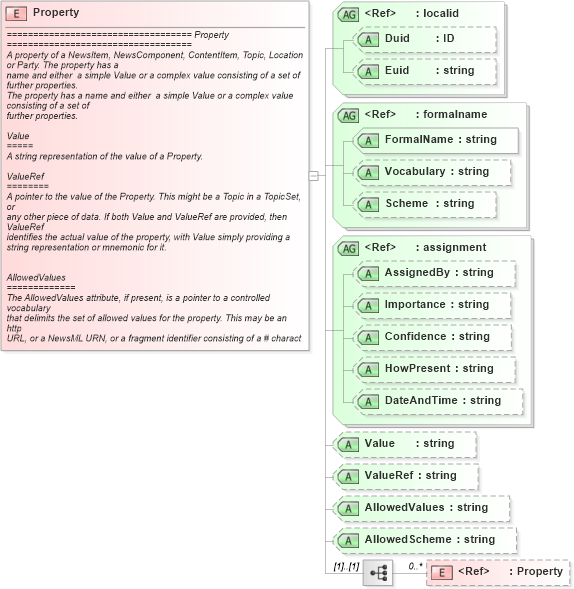
<xs:element name="Property">
    <xs:annotation>
        <xs:documentation>
=================================== Property ===================================
A property of a NewsItem, NewsComponent, ContentItem, Topic, Location or Party. The property has a
name and either  a simple Value or a complex value consisting of a set of further properties.
The property has a name and either  a simple Value or a complex value consisting of a set of
further properties.

Value
=====
A string representation of the value of a Property.

ValueRef
========
A pointer to the value of the Property. This might be a Topic in a TopicSet, or
any other piece of data. If both Value and ValueRef are provided, then ValueRef
identifies the actual value of the property, with Value simply providing a
string representation or mnemonic for it.


AllowedValues
=============
The AllowedValues attribute, if present, is a pointer to a controlled vocabulary
that delimits the set of allowed values for the property. This may be an http
URL, or a NewsML URN, or a fragment identifier consisting of a # charactger
followed by the Duid of an element in the current document. The pointer must
reference either a Resource element that designates an external controlled
vocabulary, or a TopicSet element, that is itself the controlled vocabulary.

AllowedScheme (added in Version 1.1)
=============
The AllowedScheme attribute, if present, distinguishes the Scheme in a controlled
vocabulary that delimits the set of allowed values for the property. For a match to be
obtained within the controlled vocabulary both the AllowedScheme  must match the
Scheme in the vocabulary and the Value must match the FormalName in the vocabulary.
The use of the AllowedScheme attribute serves to indicate that the Value data is
 drawn from a controlled vocabulary rather that being an uncontrolled entry.
================================================================================

			</xs:documentation>
    </xs:annotation>
    <xs:complexType>
        <xs:sequence>
            <xs:element ref="Property" minOccurs="0" maxOccurs="unbounded" />
        </xs:sequence>
        <xs:attributeGroup ref="localid" />
        <xs:attributeGroup ref="formalname" />
        <xs:attributeGroup ref="assignment" />
        <xs:attribute name="Value" type="xs:string" />
        <xs:attribute name="ValueRef" type="xs:string" />
        <xs:attribute name="AllowedValues" type="xs:string" />
        <xs:attribute name="AllowedScheme" type="xs:string" />
    </xs:complexType>
    <!--
Example:
<Catalog>
 <Resource Duid="resource1">
  <Urn>urn:newsml:reuters.com:20001001:Physical Characteristics:3</Urn>
  <Url>www.reuters.com/vocabs/physical.xml</Url>
  <Url>www.iptc.com/vocabularies/memberdefined/reuters/physical.xml</Url>
  <DefaultVocabularyFor Scheme="short" Context="Metadata/Property[@FormalName='Width']"/>
 </Resource>
</Catalog>
...
<Property FormalName="Width" Vocabulary="#resource1">
 <Property FormalName="Unit" ValueRef="urn:newsml:iptc.org:20001006:units:1#cm"/>
 <Property FormalName="Quantity" Value="7.5"/>
</Property>
-->
</xs:element>
|
 XSD Schema Diagram: