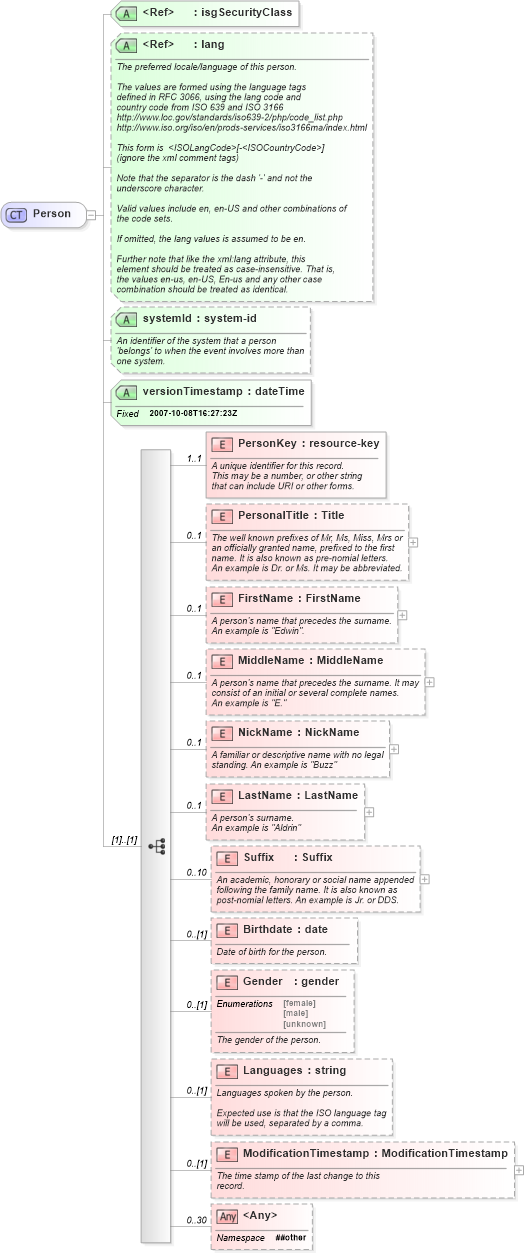
<xs:complexType name="Person">
    <xs:sequence>
        <xs:element name="PersonKey" type="commons:resource-key" minOccurs="1" maxOccurs="1">
            <xs:annotation>
                <xs:documentation>
						A unique identifier for this record.
						This may be a number, or other string
						that can include URI or other forms.
					</xs:documentation>
                <xs:appinfo>
                    <retsid>100001</retsid>
                    <example>http://www.example.com/mls/633242434</example>
                </xs:appinfo>
            </xs:annotation>
        </xs:element>
        <xs:element name="PersonalTitle" type="commons:Title" minOccurs="0" maxOccurs="1">
            <xs:annotation>
                <xs:documentation>
						The well known prefixes of Mr, Ms, Miss, Mrs or
						an officially granted name, prefixed to the first
						name. It is also known as pre-nomial letters.
						An example is Dr. or Ms. It may be abbreviated.
					</xs:documentation>
                <xs:appinfo>
                    <retsid>100002</retsid>
                    <example>Dr</example>
                </xs:appinfo>
            </xs:annotation>
        </xs:element>
        <xs:element name="FirstName" type="commons:FirstName" minOccurs="0" maxOccurs="1">
            <xs:annotation>
                <xs:documentation>
						A person's name that precedes the surname.
						An example is "Edwin".
					</xs:documentation>
                <xs:appinfo>
                    <retsid>100003</retsid>
                    <example>Edwin</example>
                </xs:appinfo>
            </xs:annotation>
        </xs:element>
        <xs:element name="MiddleName" type="commons:MiddleName" minOccurs="0" maxOccurs="1">
            <xs:annotation>
                <xs:documentation>
						A person's name that precedes the surname. It may
						consist of an initial or several complete names.
						An example is "E."
					</xs:documentation>
                <xs:appinfo>
                    <retsid>100004</retsid>
                    <example>E</example>
                </xs:appinfo>
            </xs:annotation>
        </xs:element>
        <xs:element name="NickName" type="commons:NickName" minOccurs="0" maxOccurs="1">
            <xs:annotation>
                <xs:documentation>
						A familiar or descriptive name with no legal
						standing. An example is "Buzz"
					</xs:documentation>
                <xs:appinfo>
                    <retsid>100005</retsid>
                    <example>Buzz</example>
                </xs:appinfo>
            </xs:annotation>
        </xs:element>
        <xs:element name="LastName" type="commons:LastName" minOccurs="0" maxOccurs="1">
            <xs:annotation>
                <xs:documentation>
						A person's surname.
						An example is "Aldrin"
					</xs:documentation>
                <xs:appinfo>
                    <retsid>100006</retsid>
                    <example>Aldrin</example>
                </xs:appinfo>
            </xs:annotation>
        </xs:element>
        <xs:element name="Suffix" type="commons:Suffix" minOccurs="0" maxOccurs="10">
            <xs:annotation>
                <xs:documentation>
						An academic, honorary or social name appended
						following the family name. It is also known as
						post-nomial letters. An example is Jr. or DDS.
					</xs:documentation>
                <xs:appinfo>
                    <retsid>100007</retsid>
                    <example>Jr</example>
                </xs:appinfo>
            </xs:annotation>
        </xs:element>
        <xs:element name="Birthdate" type="xs:date" minOccurs="0">
            <xs:annotation>
                <xs:documentation>
						Date of birth for the person.
					</xs:documentation>
                <xs:appinfo>
                    <retsid>100008</retsid>
                    <example>
                    </example>
                </xs:appinfo>
            </xs:annotation>
        </xs:element>
        <xs:element name="Gender" type="commons:gender" minOccurs="0">
            <xs:annotation>
                <xs:documentation>
						The gender of the person.
					</xs:documentation>
                <xs:appinfo>
                    <retsid>100009</retsid>
                    <example>male</example>
                </xs:appinfo>
            </xs:annotation>
        </xs:element>
        <xs:element name="Languages" type="xs:string" minOccurs="0">
            <xs:annotation>
                <xs:documentation>
						Languages spoken by the person.

						Expected use is that the ISO language tag
						will be used, separated by a comma.
					</xs:documentation>
                <xs:appinfo>
                    <retsid>100010</retsid>
                    <example>en, de, es</example>
                </xs:appinfo>
            </xs:annotation>
        </xs:element>
        <xs:element name="ModificationTimestamp" type="commons:ModificationTimestamp" minOccurs="0">
            <xs:annotation>
                <xs:documentation>
						The time stamp of the last change to this
						record.
					</xs:documentation>
                <xs:appinfo>
                    <retsid>100011</retsid>
                    <example>2007-03-11T12:00:00-05:00</example>
                </xs:appinfo>
            </xs:annotation>
        </xs:element>
        <xs:any namespace="##other" minOccurs="0" maxOccurs="30" />
    </xs:sequence>
    <xs:attribute ref="commons:isgSecurityClass" use="required">
        <xs:annotation>
            <xs:documentation>
            </xs:documentation>
            <xs:appinfo>
                <retsid>100012</retsid>
                <example>
                </example>
            </xs:appinfo>
        </xs:annotation>
    </xs:attribute>
    <xs:attribute ref="xml:lang" use="optional">
        <xs:annotation>
            <xs:documentation>
					The preferred locale/language of this person.

					The values are formed using the language tags
					defined in RFC 3066, using the lang code and
					country code from ISO 639 and ISO 3166
					http://www.loc.gov/standards/iso639-2/php/code_list.php
					http://www.iso.org/iso/en/prods-services/iso3166ma/index.html

					This form is <!-- <ISOLangCode>[-<ISOCountryCode>] -->
					(ignore the xml comment tags)

					Note that the separator is the dash '-' and not the
					underscore character.

					Valid values include en, en-US and other combinations of
					the code sets.

					If omitted, the lang values is assumed to be en.

					Further note that like the xml:lang attribute, this
					element should be treated as case-insensitive. That is,
					the values en-us, en-US, En-us and any other case
					combination should be treated as identical.
				</xs:documentation>
            <xs:appinfo>
                <retsid>100013</retsid>
                <example>en-US</example>
            </xs:appinfo>
        </xs:annotation>
    </xs:attribute>
    <xs:attribute name="systemId" type="commons:system-id" use="optional">
        <xs:annotation>
            <xs:documentation>
					An identifier of the system that a person
					'belongs' to when the event involves more than
					one system.
				</xs:documentation>
            <xs:appinfo>
                <retsid>100014</retsid>
                <example>
                </example>
            </xs:appinfo>
        </xs:annotation>
    </xs:attribute>
    <xs:attribute name="versionTimestamp" type="xs:dateTime" use="required" fixed="2007-10-08T16:27:23Z">
        <xs:annotation>
            <xs:appinfo>
                <retsid>100015</retsid>
            </xs:appinfo>
        </xs:annotation>
    </xs:attribute>
</xs:complexType>
|
 XSD Schema Diagram: