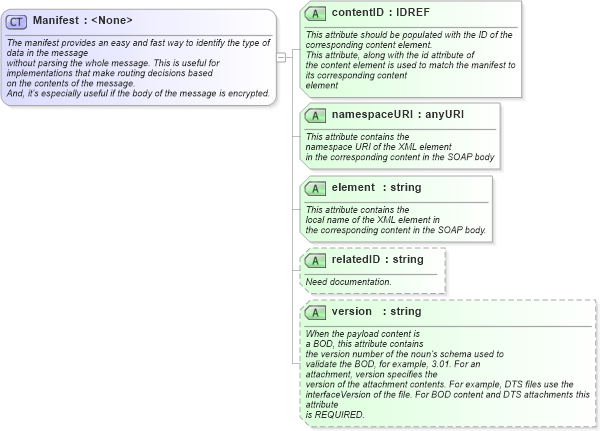
<xsd:complexType name="Manifest">
    <xsd:annotation>
        <xsd:documentation> The manifest provides an easy and fast way to identify the type of
                data in the message
                without parsing the whole message. This is useful for
                implementations that make routing decisions based
                on the contents of the message.
                And, it’s especially useful if the body of the message is encrypted.
            </xsd:documentation>
    </xsd:annotation>
    <xsd:attribute name="contentID" type="xsd:IDREF" use="required">
        <xsd:annotation>
            <xsd:documentation> This attribute should be populated with the ID of the
                    corresponding content element.
                    This attribute, along with the id attribute of
                    the content element is used to match the manifest to
                    its corresponding content
                    element </xsd:documentation>
        </xsd:annotation>
    </xsd:attribute>
    <xsd:attribute name="namespaceURI" type="xsd:anyURI" use="required">
        <xsd:annotation>
            <xsd:documentation source="http://www.starstandard.org"> This attribute contains the
                    namespace URI of the XML element
                    in the corresponding content in the SOAP body
				</xsd:documentation>
        </xsd:annotation>
    </xsd:attribute>
    <xsd:attribute name="element" type="xsd:string" use="required">
        <xsd:annotation>
            <xsd:documentation source="http://www.starstandard.org"> This attribute contains the
                    local name of the XML element in
                    the corresponding content in the SOAP body.
				</xsd:documentation>
        </xsd:annotation>
    </xsd:attribute>
    <xsd:attribute name="relatedID" type="xsd:string" use="optional">
        <xsd:annotation>
            <xsd:documentation source="http://www.starstandard.org"> Need documentation.
				</xsd:documentation>
        </xsd:annotation>
    </xsd:attribute>
    <xsd:attribute name="version" type="xsd:string" use="optional">
        <xsd:annotation>
            <xsd:documentation source="http://www.starstandard.org"> When the payload content is
                    a BOD, this attribute contains
                    the version number of the noun’s schema used to
                    validate the BOD, for example, 3.01. For an
                    attachment, version specifies the
                    version of the attachment contents. For example, DTS files use the
                    interfaceVersion of the file. For BOD content and DTS attachments this attribute
                    is REQUIRED.
                </xsd:documentation>
        </xsd:annotation>
    </xsd:attribute>
</xsd:complexType>
|
 XSD Schema Diagram: