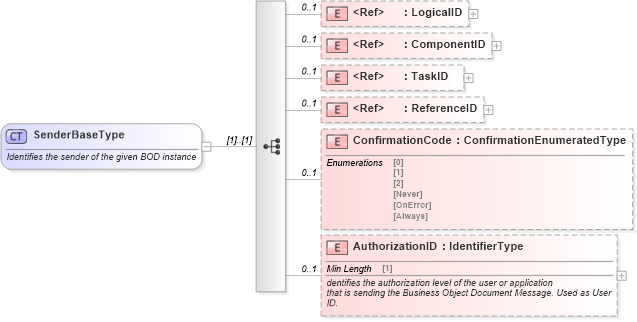
<xsd:complexType name="SenderBaseType">
    <xsd:annotation>
        <xsd:documentation>Identifies the sender of the given BOD instance</xsd:documentation>
    </xsd:annotation>
    <xsd:sequence>
        <xsd:element maxOccurs="1" minOccurs="0" ref="LogicalID">
            <xsd:annotation>
                <xsd:documentation source="http://www.starstandard.org">This is the logical location of the server and application
                  from which the Business Object Document originated.</xsd:documentation>
            </xsd:annotation>
        </xsd:element>
        <xsd:element maxOccurs="1" minOccurs="0" ref="ComponentID">
            <xsd:annotation>
                <xsd:documentation source="http://www.starstandard.org">DCS software code name.</xsd:documentation>
            </xsd:annotation>
        </xsd:element>
        <xsd:element maxOccurs="1" minOccurs="0" ref="TaskID">
            <xsd:annotation>
                <xsd:documentation source="http://www.starstandard.org">This describes the business event that initiated the need for
                  the Business Object Document to be created.</xsd:documentation>
            </xsd:annotation>
        </xsd:element>
        <xsd:element maxOccurs="1" minOccurs="0" ref="ReferenceID">
            <xsd:annotation>
                <xsd:documentation source="http://www.starstandard.org">Enables the sending application to indicate the instance
                  identifier of the event or task that caused the BOD to be created.  This is used to correlate a
                  response BOD to an originating BOD. *The Sender of the originating application will populate the
                  Reference Id with business level information. *Reference ID does not have to be a GUID. It must be a
                  locally unique application value for the transaction type, for example a database sequence number.
                  *The receiving application puts the value in Reference ID of the incoming message in the Reference ID
                  of any acknowledgement messages. *The Reference Id will not be required to tie two collaborations
                  together such as Parts Order and Parts Shipment.</xsd:documentation>
            </xsd:annotation>
        </xsd:element>
        <xsd:element maxOccurs="1" minOccurs="0" name="ConfirmationCode" type="scl:ConfirmationEnumeratedType">
            <xsd:annotation>
                <xsd:documentation />
            </xsd:annotation>
        </xsd:element>
        <xsd:element maxOccurs="1" minOccurs="0" name="AuthorizationID" type="udt:IdentifierType">
            <xsd:annotation>
                <xsd:documentation source="http://www.starstandard.org">dentifies the authorization level of the user or application
                  that is sending the Business Object Document Message. Used as User ID.</xsd:documentation>
            </xsd:annotation>
        </xsd:element>
    </xsd:sequence>
</xsd:complexType>
|
 XSD Schema Diagram: