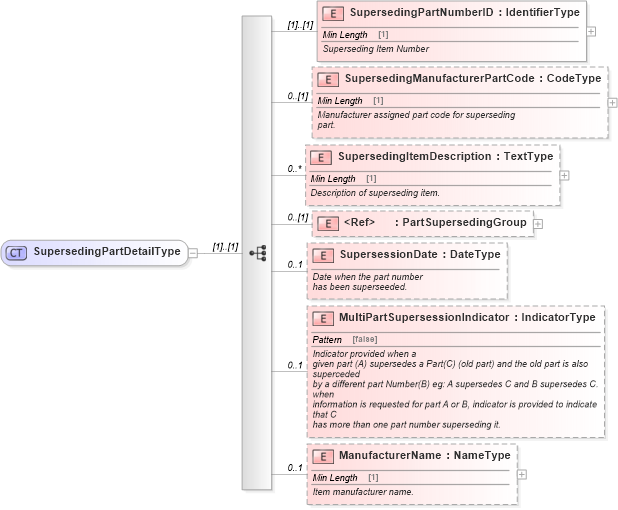
<xsd:complexType name="SupersedingPartDetailType">
    <xsd:sequence>
        <xsd:element name="SupersedingPartNumberID" type="udt:IdentifierType">
            <xsd:annotation>
                <xsd:documentation>
                        Superseding Item Number
                    </xsd:documentation>
            </xsd:annotation>
        </xsd:element>
        <xsd:element minOccurs="0" name="SupersedingManufacturerPartCode" type="udt:CodeType">
            <xsd:annotation>
                <xsd:documentation>
                        Manufacturer assigned part code for superseding
                        part.
                    </xsd:documentation>
            </xsd:annotation>
        </xsd:element>
        <xsd:element maxOccurs="unbounded" minOccurs="0" name="SupersedingItemDescription" type="udt:TextType">
            <xsd:annotation>
                <xsd:documentation>
                        Description of superseding item.
                    </xsd:documentation>
            </xsd:annotation>
        </xsd:element>
        <xsd:element minOccurs="0" ref="PartSupersedingGroup">
            <xsd:annotation>
                <xsd:documentation>
                        Contains a grouping of part numbers that supersed this
                            superseded part.
                    </xsd:documentation>
            </xsd:annotation>
        </xsd:element>
        <xsd:element maxOccurs="1" minOccurs="0" name="SupersessionDate" type="udt:DateType">
            <xsd:annotation>
                <xsd:documentation source="http://www.starstandard.org/STAR/5">Date when the part number
                has been superseeded.</xsd:documentation>
            </xsd:annotation>
        </xsd:element>
        <xsd:element maxOccurs="1" minOccurs="0" name="MultiPartSupersessionIndicator" type="udt:IndicatorType">
            <xsd:annotation>
                <xsd:documentation source="http://www.starstandard.org/STAR/5">Indicator provided when a
                given part (A) supersedes a Part(C) (old part) and the old part is also superceded
                by a different part Number(B) eg: A supersedes C and B supersedes C. when
                information is requested for part A or B, indicator is provided to indicate that C
                has more than one part number superseding it.</xsd:documentation>
            </xsd:annotation>
        </xsd:element>
        <xsd:element maxOccurs="1" minOccurs="0" name="ManufacturerName" type="udt:NameType">
            <xsd:annotation>
                <xsd:documentation source="http://www.starstandard.org/STAR/5">Item manufacturer name.</xsd:documentation>
            </xsd:annotation>
        </xsd:element>
    </xsd:sequence>
</xsd:complexType>
|
 XSD Schema Diagram: