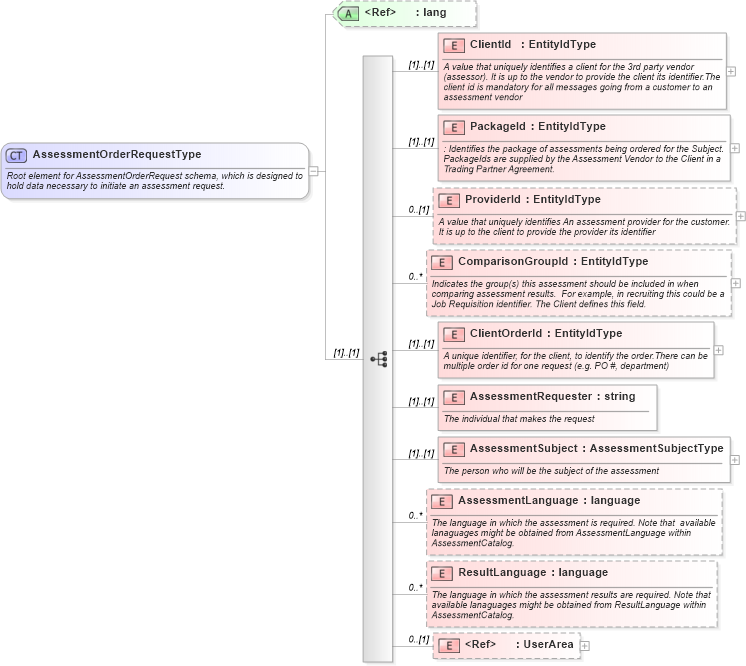
<xsd:complexType name="AssessmentOrderRequestType">
    <xsd:annotation>
        <xsd:documentation>Root element for AssessmentOrderRequest schema, which is designed to hold data necessary to initiate an assessment request.</xsd:documentation>
    </xsd:annotation>
    <xsd:sequence>
        <xsd:element name="ClientId" type="EntityIdType">
            <xsd:annotation>
                <xsd:documentation>A value that uniquely identifies a client for the 3rd party vendor (assessor). It is up to the vendor to provide the client its identifier.The client id is mandatory for all messages going from a customer to an assessment vendor</xsd:documentation>
            </xsd:annotation>
        </xsd:element>
        <xsd:element name="PackageId" type="EntityIdType">
            <xsd:annotation>
                <xsd:documentation>: Identifies the package of assessments being ordered for the Subject. PackageIds are supplied by the Assessment Vendor to the Client in a Trading Partner Agreement.</xsd:documentation>
            </xsd:annotation>
        </xsd:element>
        <xsd:element name="ProviderId" type="EntityIdType" minOccurs="0">
            <xsd:annotation>
                <xsd:documentation>A value that uniquely identifies An assessment provider for the customer. It is up to the client to provide the provider its identifier</xsd:documentation>
            </xsd:annotation>
        </xsd:element>
        <xsd:element name="ComparisonGroupId" type="EntityIdType" minOccurs="0" maxOccurs="unbounded">
            <xsd:annotation>
                <xsd:documentation>Indicates the group(s) this assessment should be included in when comparing assessment results.  For example, in recruiting this could be a Job Requisition identifier. The Client defines this field.</xsd:documentation>
            </xsd:annotation>
        </xsd:element>
        <xsd:element name="ClientOrderId" type="EntityIdType">
            <xsd:annotation>
                <xsd:documentation>A unique identifier, for the client, to identify the order.There can be multiple order id for one request (e.g. PO #, department)</xsd:documentation>
            </xsd:annotation>
        </xsd:element>
        <xsd:element name="AssessmentRequester" type="xsd:string">
            <xsd:annotation>
                <xsd:documentation>The individual that makes the request</xsd:documentation>
            </xsd:annotation>
        </xsd:element>
        <xsd:element name="AssessmentSubject" type="AssessmentSubjectType">
            <xsd:annotation>
                <xsd:documentation>The person who will be the subject of the assessment</xsd:documentation>
            </xsd:annotation>
        </xsd:element>
        <xsd:element name="AssessmentLanguage" type="xsd:language" minOccurs="0" maxOccurs="unbounded">
            <xsd:annotation>
                <xsd:documentation>The language in which the assessment is required. Note that  available lanaguages might be obtained from AssessmentLanguage within AssessmentCatalog.</xsd:documentation>
            </xsd:annotation>
        </xsd:element>
        <xsd:element name="ResultLanguage" type="xsd:language" minOccurs="0" maxOccurs="unbounded">
            <xsd:annotation>
                <xsd:documentation>The language in which the assessment results are required. Note that  available lanaguages might be obtained from ResultLanguage within AssessmentCatalog.</xsd:documentation>
            </xsd:annotation>
        </xsd:element>
        <xsd:element ref="UserArea" minOccurs="0" />
    </xsd:sequence>
    <xsd:attribute ref="xml:lang" />
</xsd:complexType>
|
 XSD Schema Diagram: