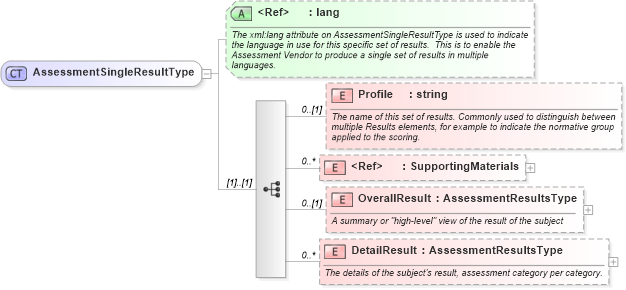
<xsd:complexType name="AssessmentSingleResultType">
    <xsd:sequence>
        <xsd:element name="Profile" type="xsd:string" minOccurs="0">
            <xsd:annotation>
                <xsd:documentation>The name of this set of results. Commonly used to distinguish between multiple Results elements, for example to indicate the normative group applied to the scoring.</xsd:documentation>
            </xsd:annotation>
        </xsd:element>
        <xsd:element ref="SupportingMaterials" minOccurs="0" maxOccurs="unbounded" />
        <xsd:element name="OverallResult" type="AssessmentResultsType" minOccurs="0">
            <xsd:annotation>
                <xsd:documentation>A summary or "high-level" view of the result of the subject</xsd:documentation>
            </xsd:annotation>
        </xsd:element>
        <xsd:element name="DetailResult" type="AssessmentResultsType" minOccurs="0" maxOccurs="unbounded">
            <xsd:annotation>
                <xsd:documentation>The details of the subject's result, assessment category per category.</xsd:documentation>
            </xsd:annotation>
        </xsd:element>
    </xsd:sequence>
    <xsd:attribute ref="xml:lang" use="optional">
        <xsd:annotation>
            <xsd:documentation>The xml:lang attribute on AssessmentSingleResultType is used to indicate the language in use for this specific set of results.  This is to enable the Assessment Vendor to produce a single set of results in multiple languages.</xsd:documentation>
        </xsd:annotation>
    </xsd:attribute>
</xsd:complexType>
|
 XSD Schema Diagram: