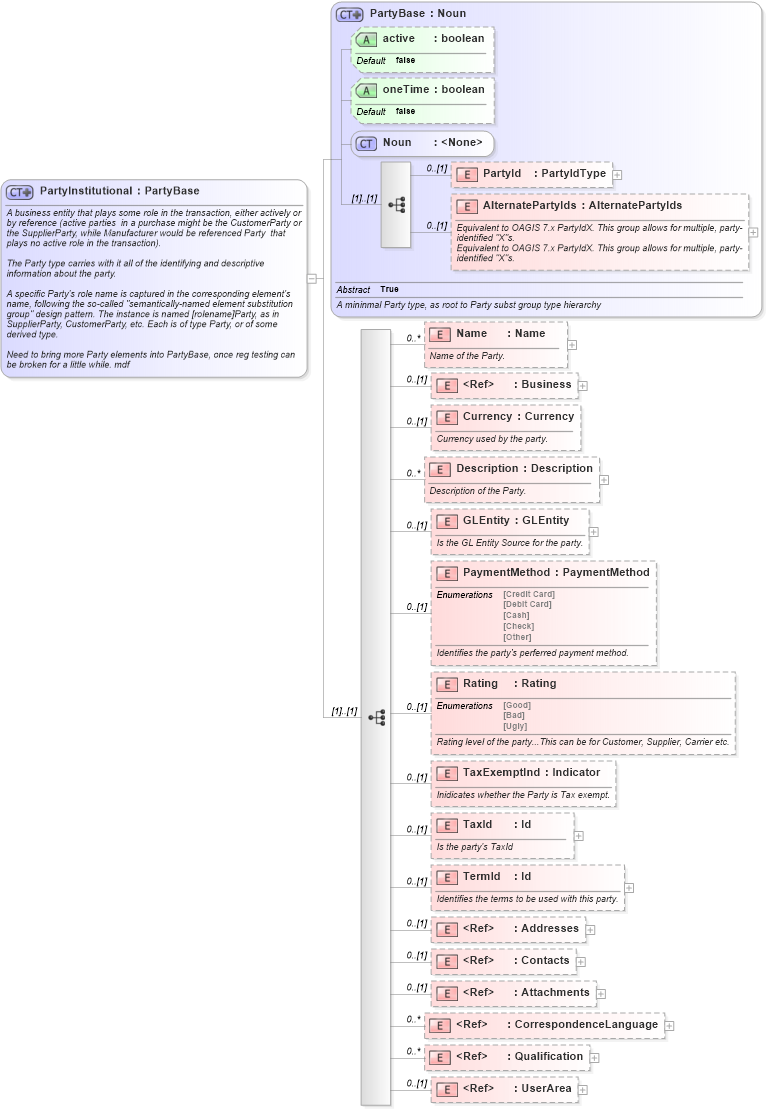
<xs:complexType name="PartyInstitutional">
    <xs:annotation>
        <xs:documentation source="http://www.openapplications.org/oagis">A business entity that plays some role in the transaction, either actively or  by reference (active parties  in a purchase might be the CustomerParty or the SupplierParty, while Manufacturer would be referenced Party  that plays no active role in the transaction).

The Party type carries with it all of the identifying and descriptive information about the party.

A specific Party's role name is captured in the corresponding element's name, following the so-called "semantically-named element substitution group" design pattern. The instance is named [rolename]Party, as in SupplierParty, CustomerParty, etc. Each is of type Party, or of some derived type.

Need to bring more Party elements into PartyBase, once reg testing can be broken for a little while. mdf</xs:documentation>
    </xs:annotation>
    <xs:complexContent>
        <xs:extension base="PartyBase">
            <xs:sequence>
                <xs:element name="Name" type="Name" minOccurs="0" maxOccurs="unbounded">
                    <xs:annotation>
                        <xs:documentation source="http://www.openapplications.org/oagis">Name of the Party.</xs:documentation>
                    </xs:annotation>
                </xs:element>
                <xs:element ref="Business" minOccurs="0" />
                <xs:element name="Currency" type="Currency" minOccurs="0">
                    <xs:annotation>
                        <xs:documentation source="http://www.openapplications.org/oagis">Currency used by the party.</xs:documentation>
                    </xs:annotation>
                </xs:element>
                <xs:element name="Description" type="Description" minOccurs="0" maxOccurs="unbounded">
                    <xs:annotation>
                        <xs:documentation source="http://www.openapplications.org/oagis">Description of the Party.</xs:documentation>
                    </xs:annotation>
                </xs:element>
                <xs:element name="GLEntity" type="GLEntity" minOccurs="0">
                    <xs:annotation>
                        <xs:documentation source="http://www.openapplications.org/oagis">Is the GL Entity Source for the party.</xs:documentation>
                    </xs:annotation>
                </xs:element>
                <xs:element name="PaymentMethod" type="PaymentMethod" minOccurs="0">
                    <xs:annotation>
                        <xs:documentation source="http://www.openapplications.org/oagis">Identifies the party's perferred payment method.</xs:documentation>
                    </xs:annotation>
                </xs:element>
                <xs:element name="Rating" type="Rating" minOccurs="0">
                    <xs:annotation>
                        <xs:documentation source="http://www.openapplications.org/oagis">Rating level of the party...This can be for Customer, Supplier, Carrier etc.</xs:documentation>
                    </xs:annotation>
                </xs:element>
                <xs:element name="TaxExemptInd" type="Indicator" minOccurs="0">
                    <xs:annotation>
                        <xs:documentation source="http://www.openapplications.org/oagis">Inidicates whether the Party is Tax exempt.</xs:documentation>
                    </xs:annotation>
                </xs:element>
                <xs:element name="TaxId" type="Id" minOccurs="0">
                    <xs:annotation>
                        <xs:documentation source="http://www.openapplications.org/oagis">Is the party's TaxId</xs:documentation>
                    </xs:annotation>
                </xs:element>
                <xs:element name="TermId" type="Id" minOccurs="0">
                    <xs:annotation>
                        <xs:documentation source="http://www.openapplications.org/oagis">Identifies the terms to be used with this party.</xs:documentation>
                    </xs:annotation>
                </xs:element>
                <xs:element ref="Addresses" minOccurs="0" />
                <xs:element ref="Contacts" minOccurs="0" />
                <xs:element ref="Attachments" minOccurs="0" />
                <xs:element ref="CorrespondenceLanguage" minOccurs="0" maxOccurs="unbounded" />
                <xs:element ref="Qualification" minOccurs="0" maxOccurs="unbounded" />
                <xs:element ref="UserArea" minOccurs="0" />
            </xs:sequence>
        </xs:extension>
    </xs:complexContent>
</xs:complexType>
|
 XSD Schema Diagram: