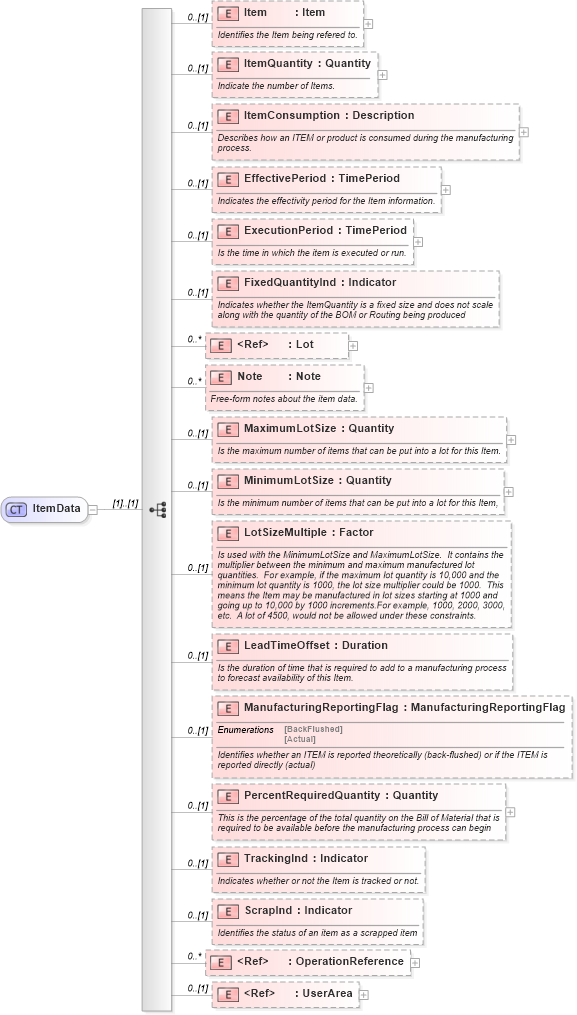
<xs:complexType name="ItemData">
    <xs:sequence>
        <xs:element name="Item" type="Item" minOccurs="0">
            <xs:annotation>
                <xs:documentation source="http://www.openapplications.org/oagis">Identifies the Item being refered to.</xs:documentation>
            </xs:annotation>
        </xs:element>
        <xs:element name="ItemQuantity" type="Quantity" minOccurs="0">
            <xs:annotation>
                <xs:documentation source="http://www.openapplications.org/oagis">Indicate the number of Items.</xs:documentation>
            </xs:annotation>
        </xs:element>
        <xs:element name="ItemConsumption" type="Description" minOccurs="0">
            <xs:annotation>
                <xs:documentation source="http://www.openapplications.org/oagis">Describes how an ITEM or product is consumed during the manufacturing process.</xs:documentation>
            </xs:annotation>
        </xs:element>
        <xs:element name="EffectivePeriod" type="TimePeriod" minOccurs="0">
            <xs:annotation>
                <xs:documentation source="http://www.openapplications.org/oagis">Indicates the effectivity period for the Item information.</xs:documentation>
            </xs:annotation>
        </xs:element>
        <xs:element name="ExecutionPeriod" type="TimePeriod" minOccurs="0">
            <xs:annotation>
                <xs:documentation source="http://www.openapplications.org/oagis">Is the time in which the item is executed or run.</xs:documentation>
            </xs:annotation>
        </xs:element>
        <xs:element name="FixedQuantityInd" type="Indicator" minOccurs="0">
            <xs:annotation>
                <xs:documentation source="http://www.openapplications.org/oagis">Indicates whether the ItemQuantity is a fixed size and does not scale along with the quantity of the BOM or Routing being produced</xs:documentation>
            </xs:annotation>
        </xs:element>
        <xs:element ref="Lot" minOccurs="0" maxOccurs="unbounded" />
        <xs:element name="Note" type="Note" minOccurs="0" maxOccurs="unbounded">
            <xs:annotation>
                <xs:documentation source="http://www.openapplications.org/oagis">Free-form notes about the item data.</xs:documentation>
            </xs:annotation>
        </xs:element>
        <xs:element name="MaximumLotSize" type="Quantity" minOccurs="0">
            <xs:annotation>
                <xs:documentation source="http://www.openapplications.org/oagis">Is the maximum number of items that can be put into a lot for this Item.</xs:documentation>
            </xs:annotation>
        </xs:element>
        <xs:element name="MinimumLotSize" type="Quantity" minOccurs="0">
            <xs:annotation>
                <xs:documentation source="http://www.openapplications.org/oagis">Is the minimum number of items that can be put into a lot for this Item,</xs:documentation>
            </xs:annotation>
        </xs:element>
        <xs:element name="LotSizeMultiple" type="Factor" minOccurs="0">
            <xs:annotation>
                <xs:documentation source="http://www.openapplications.org/oagis">Is used with the MinimumLotSize and MaximumLotSize.  It contains the multiplier between the minimum and maximum manufactured lot quantities.  For example, if the maximum lot quantity is 10,000 and the minimum lot quantity is 1000, the lot size multiplier could be 1000.  This means the Item may be manufactured in lot sizes starting at 1000 and going up to 10,000 by 1000 increments.For example, 1000, 2000, 3000, etc.  A lot of 4500, would not be allowed under these constraints.</xs:documentation>
            </xs:annotation>
        </xs:element>
        <xs:element name="LeadTimeOffset" type="Duration" minOccurs="0">
            <xs:annotation>
                <xs:documentation source="http://www.openapplications.org/oagis">Is the duration of time that is required to add to a manufacturing process to forecast availability of this Item.</xs:documentation>
            </xs:annotation>
        </xs:element>
        <xs:element name="ManufacturingReportingFlag" type="ManufacturingReportingFlag" minOccurs="0">
            <xs:annotation>
                <xs:documentation source="http://www.openapplications.org/oagis">Identifies whether an ITEM is reported theoretically (back-flushed) or if the ITEM is reported directly (actual)</xs:documentation>
            </xs:annotation>
        </xs:element>
        <xs:element name="PercentRequiredQuantity" type="Quantity" minOccurs="0">
            <xs:annotation>
                <xs:documentation source="http://www.openapplications.org/oagis">This is the percentage of the total quantity on the Bill of Material that is required to be available before the manufacturing process can begin</xs:documentation>
            </xs:annotation>
        </xs:element>
        <xs:element name="TrackingInd" type="Indicator" minOccurs="0">
            <xs:annotation>
                <xs:documentation source="http://www.openapplications.org/oagis">Indicates whether or not the Item is tracked or not.</xs:documentation>
            </xs:annotation>
        </xs:element>
        <xs:element name="ScrapInd" type="Indicator" minOccurs="0">
            <xs:annotation>
                <xs:documentation source="http://www.openapplications.org/oagis">Identifies the status of an item as a scrapped item</xs:documentation>
            </xs:annotation>
        </xs:element>
        <xs:element ref="OperationReference" minOccurs="0" maxOccurs="unbounded" />
        <xs:element ref="UserArea" minOccurs="0" />
    </xs:sequence>
</xs:complexType>
|
 XSD Schema Diagram: