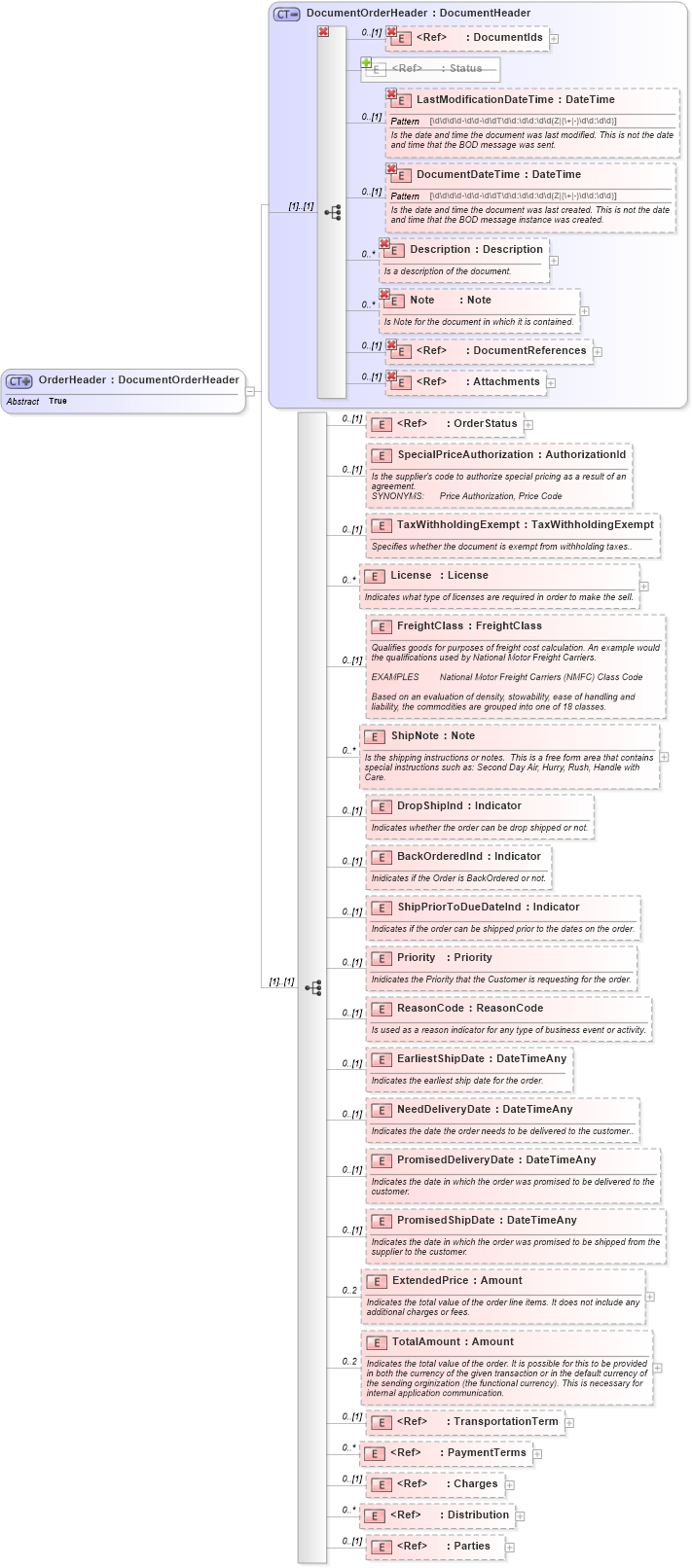
<xs:complexType name="OrderHeader" abstract="true">
    <xs:complexContent>
        <xs:extension base="DocumentOrderHeader">
            <xs:sequence>
                <xs:element ref="OrderStatus" minOccurs="0" />
                <xs:element name="SpecialPriceAuthorization" type="AuthorizationId" minOccurs="0">
                    <xs:annotation>
                        <xs:documentation source="http://www.openapplications.org/oagis">Is the supplier's code to authorize special pricing as a result of an agreement.</xs:documentation>
                        <xs:documentation source="http://www.openapplications.org/oagis">SYNONYMS:	Price Authorization, Price Code</xs:documentation>
                    </xs:annotation>
                </xs:element>
                <xs:element name="TaxWithholdingExempt" type="TaxWithholdingExempt" minOccurs="0">
                    <xs:annotation>
                        <xs:documentation source="http://www.openapplications.org/oagis">Specifies whether the document is exempt from withholding taxes..</xs:documentation>
                    </xs:annotation>
                </xs:element>
                <xs:element name="License" type="License" minOccurs="0" maxOccurs="unbounded">
                    <xs:annotation>
                        <xs:documentation source="http://www.openapplications.org/oagis">Indicates what type of licenses are required in order to make the sell.</xs:documentation>
                    </xs:annotation>
                </xs:element>
                <xs:element name="FreightClass" type="FreightClass" minOccurs="0">
                    <xs:annotation>
                        <xs:documentation source="http://www.openapplications.org/oagis">Qualifies goods for purposes of freight cost calculation. An example would the qualifications used by National Motor Freight Carriers.

EXAMPLES	National Motor Freight Carriers (NMFC) Class Code

Based on an evaluation of density, stowability, ease of handling and liability, the commodities are grouped into one of 18 classes.</xs:documentation>
                    </xs:annotation>
                </xs:element>
                <xs:element name="ShipNote" type="Note" minOccurs="0" maxOccurs="unbounded">
                    <xs:annotation>
                        <xs:documentation source="http://www.openapplications.org/oagis">Is the shipping instructions or notes.  This is a free form area that contains special instructions such as: Second Day Air, Hurry, Rush, Handle with Care.</xs:documentation>
                    </xs:annotation>
                </xs:element>
                <xs:element name="DropShipInd" type="Indicator" minOccurs="0">
                    <xs:annotation>
                        <xs:documentation source="http://www.openapplications.org/oagis">Indicates whether the order can be drop shipped or not.</xs:documentation>
                    </xs:annotation>
                </xs:element>
                <xs:element name="BackOrderedInd" type="Indicator" minOccurs="0">
                    <xs:annotation>
                        <xs:documentation source="http://www.openapplications.org/oagis">Inidicates if the Order is BackOrdered or not.</xs:documentation>
                    </xs:annotation>
                </xs:element>
                <xs:element name="ShipPriorToDueDateInd" type="Indicator" minOccurs="0">
                    <xs:annotation>
                        <xs:documentation source="http://www.openapplications.org/oagis">Indicates if the order can be shipped prior to the dates on the order.</xs:documentation>
                    </xs:annotation>
                </xs:element>
                <xs:element name="Priority" type="Priority" minOccurs="0">
                    <xs:annotation>
                        <xs:documentation source="http://www.openapplications.org/oagis">Inidicates the Priority that the Customer is requesting for the order.</xs:documentation>
                    </xs:annotation>
                </xs:element>
                <xs:element name="ReasonCode" type="ReasonCode" minOccurs="0">
                    <xs:annotation>
                        <xs:documentation source="http://www.openapplications.org/oagis">Is used as a reason indicator for any type of business event or activity.</xs:documentation>
                    </xs:annotation>
                </xs:element>
                <xs:element name="EarliestShipDate" type="DateTimeAny" minOccurs="0">
                    <xs:annotation>
                        <xs:documentation source="http://www.openapplications.org/oagis">Indicates the earliest ship date for the order.</xs:documentation>
                    </xs:annotation>
                </xs:element>
                <xs:element name="NeedDeliveryDate" type="DateTimeAny" minOccurs="0">
                    <xs:annotation>
                        <xs:documentation source="http://www.openapplications.org/oagis">Indicates the date the order needs to be delivered to the customer..</xs:documentation>
                    </xs:annotation>
                </xs:element>
                <xs:element name="PromisedDeliveryDate" type="DateTimeAny" minOccurs="0">
                    <xs:annotation>
                        <xs:documentation source="http://www.openapplications.org/oagis">Indicates the date in which the order was promised to be delivered to the customer.</xs:documentation>
                    </xs:annotation>
                </xs:element>
                <xs:element name="PromisedShipDate" type="DateTimeAny" minOccurs="0">
                    <xs:annotation>
                        <xs:documentation source="http://www.openapplications.org/oagis">Indicates the date in which the order was promised to be shipped from the supplier to the customer.</xs:documentation>
                    </xs:annotation>
                </xs:element>
                <xs:element name="ExtendedPrice" type="Amount" minOccurs="0" maxOccurs="2">
                    <xs:annotation>
                        <xs:documentation source="http://www.openapplications.org/oagis">Indicates the total value of the order line items. It does not include any additional charges or fees.</xs:documentation>
                    </xs:annotation>
                </xs:element>
                <xs:element name="TotalAmount" type="Amount" minOccurs="0" maxOccurs="2">
                    <xs:annotation>
                        <xs:documentation source="http://www.openapplications.org/oagis">Indicates the total value of the order. It is possible for this to be provided in both the currency of the given transaction or in the default currency of the sending orginization (the functional currency). This is necessary for internal application communication.</xs:documentation>
                    </xs:annotation>
                </xs:element>
                <xs:element ref="TransportationTerm" minOccurs="0" />
                <xs:element ref="PaymentTerms" minOccurs="0" maxOccurs="unbounded" />
                <xs:element ref="Charges" minOccurs="0" />
                <xs:element ref="Distribution" minOccurs="0" maxOccurs="unbounded" />
                <xs:element ref="Parties" minOccurs="0" />
            </xs:sequence>
        </xs:extension>
    </xs:complexContent>
</xs:complexType>
|
 XSD Schema Diagram: