Definition Type: Element
Name: AddRFQ
Namespace: http://www.openapplications.org/oagis/9
Type: nsA:AddRFQType
Containing Schema: AddRFQ.xsd
Abstract
Documentation:
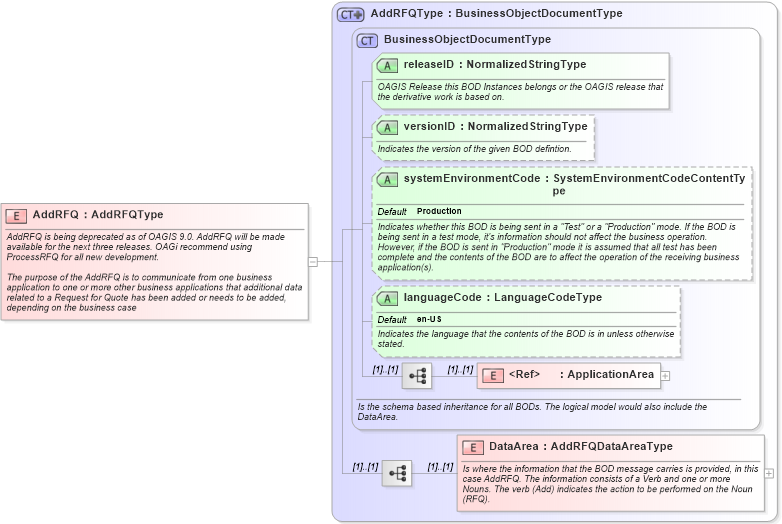
AddRFQ is being deprecated as of OAGIS 9.0. AddRFQ will be made available for the next three releases. OAGi recommend using ProcessRFQ for all new development. The purpose of the AddRFQ is to communicate from one business application to one or more other business applications that additional data related to a Request for Quote has been added or needs to be added, depending on the business case
Collapse XSD Schema Diagram:
Drilldown into DataArea in schema addrfq_xsd Drilldown into ApplicationArea in schema meta_xsd Drilldown into languageCode in schema meta_xsd Drilldown into systemEnvironmentCode in schema meta_xsd Drilldown into versionID in schema meta_xsd Drilldown into releaseID in schema meta_xsd Drilldown into BusinessObjectDocumentType in schema meta_xsd Drilldown into AddRFQType in schema addrfq_xsdXSD Diagram of AddRFQ in schema addrfq_xsd (Open Applications Group (OAGIS))
Collapse XSD Schema Code:
<xsd:element name="AddRFQ" type="AddRFQType">
    <xsd:annotation>
        <xsd:documentation source="http://www.openapplications.org/oagis/9">AddRFQ is being deprecated as of OAGIS 9.0. AddRFQ will be made available for the next three releases. OAGi recommend using ProcessRFQ for all new development.

The purpose of the AddRFQ is to communicate from one business application to one or more other business applications that additional data related to a Request for Quote has been added or needs to be added, depending on the business case</xsd:documentation>
    </xsd:annotation>
</xsd:element>
Collapse Child Elements:
Name Type Min Occurs Max Occurs
ApplicationArea nsA:ApplicationArea (1) (1)
DataArea nsA:DataArea (1) (1)
Collapse Child Attributes:
Name Type Default Value Use
releaseID nsA:releaseID Required
versionID nsA:versionID Optional
systemEnvironmentCode nsA:systemEnvironmentCode Production Optional
languageCode nsA:languageCode en-US Optional
Collapse Derivation Tree: