Definition Type: Element
Name: ListPurchaseOrder
Namespace: http://www.openapplications.org/oagis/9
Type: nsA:ListPurchaseOrderType
Containing Schema: ListPurchaseOrder.xsd
Abstract
Documentation:
In an effort to simpilify the usage of the verbs the ListPurchaseOrder BOD is being depricated as of OAGIS 9.0, the ListPurchaseOrder will still be provided for the next three releases at which time it is scheduled to be removed from OAGIS. As such for all new development we recommend that you use the ShowPurchaseOrder BOD which may serve the same function of the ListPurchaseOrder BOD. The purpose of the List PurchaseOrder is to send information relative to demand for goods or services to another business application. This may be in response to a GetList PurchaseOrder request, or it may be a notification vehicle, initiated upon an event in a business application. The List verb describes the behavior of supplying one or several documents in a summary format to the requesting business application. These listings of information may be supplied for Purchase Orders, PO Lines, or PO Sub-Lines. This BOD usually does not cause updates to occur and may be used as part of a larger integration scenario or as a single tool for communicating demand. There are many possible business applications in several environments that may use this capability. For example: 1. A PO application could use this BOD to send information to a Plant Data Collection application. 3. A MRP, Inventory or Manufacturing business application could use this to obtain order information.
Collapse XSD Schema Diagram:
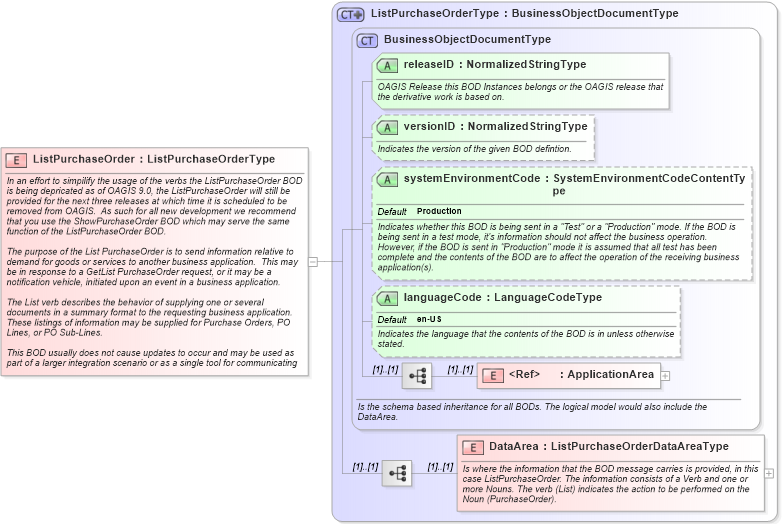
Drilldown into DataArea in schema listpurchaseorder_xsd Drilldown into ApplicationArea in schema meta_xsd Drilldown into languageCode in schema meta_xsd Drilldown into systemEnvironmentCode in schema meta_xsd Drilldown into versionID in schema meta_xsd Drilldown into releaseID in schema meta_xsd Drilldown into BusinessObjectDocumentType in schema meta_xsd Drilldown into ListPurchaseOrderType in schema listpurchaseorder_xsdXSD Diagram of ListPurchaseOrder in schema listpurchaseorder_xsd (Open Applications Group (OAGIS))
Collapse XSD Schema Code:
<xsd:element name="ListPurchaseOrder" type="ListPurchaseOrderType">
    <xsd:annotation>
        <xsd:documentation source="http://www.openapplications.org/oagis/9">In an effort to simpilify the usage of the verbs the ListPurchaseOrder BOD is being depricated as of OAGIS 9.0, the ListPurchaseOrder will still be provided for the next three releases at which time it is scheduled to be removed from OAGIS.  As such for all new development we recommend that you use the ShowPurchaseOrder BOD which may serve the same function of the ListPurchaseOrder BOD.

The purpose of the List PurchaseOrder is to send information relative to demand for goods or services to another business application.  This may be in response to a GetList PurchaseOrder request, or it may be a notification vehicle, initiated upon an event in a business application.

The List verb describes the behavior of supplying one or several documents in a summary format to the requesting business application.  These listings of information may be supplied for Purchase Orders, PO Lines, or PO Sub-Lines.

This BOD usually does not cause updates to occur and may be used as part of a larger integration scenario or as a single tool for communicating demand. There are many possible business applications in several environments that may use this capability.

For example:

1. A PO application could use this BOD to send information to a Plant Data Collection application.

3. A MRP, Inventory or Manufacturing business application could use this to obtain order information.

</xsd:documentation>
    </xsd:annotation>
</xsd:element>
Collapse Child Elements:
Name Type Min Occurs Max Occurs
ApplicationArea nsA:ApplicationArea (1) (1)
DataArea nsA:DataArea (1) (1)
Collapse Child Attributes:
Name Type Default Value Use
releaseID nsA:releaseID Required
versionID nsA:versionID Optional
systemEnvironmentCode nsA:systemEnvironmentCode Production Optional
languageCode nsA:languageCode en-US Optional
Collapse Derivation Tree: