Definition Type: Element
Name: PurchaseOrder
Namespace: http://www.openapplications.org/oagis/9
Type: nsA:PurchaseOrderType
Containing Schema: PurchaseOrder.xsd
Abstract
Documentation:
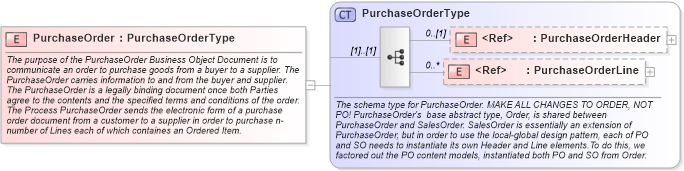
The purpose of the PurchaseOrder Business Object Document is to communicate an order to purchase goods from a buyer to a supplier. The PurchaseOrder carries information to and from the buyer and supplier. The PurchaseOrder is a legally binding document once both Parties agree to the contents and the specified terms and conditions of the order. The Process PurchaseOrder sends the electronic form of a purchase order document from a customer to a supplier in order to purchase n-number of Lines each of which containes an Ordered Item.
Collapse XSD Schema Diagram:
Drilldown into PurchaseOrderLine in schema purchaseorder_xsd Drilldown into PurchaseOrderHeader in schema purchaseorder_xsd Drilldown into PurchaseOrderType in schema purchaseorder_xsdXSD Diagram of PurchaseOrder in schema purchaseorder_xsd (Open Applications Group (OAGIS))
Collapse XSD Schema Code:
<xsd:element name="PurchaseOrder" type="PurchaseOrderType">
    <xsd:annotation>
        <xsd:documentation source="http://www.openapplications.org/oagis/9">The purpose of the PurchaseOrder Business Object Document is to communicate an order to purchase goods from a buyer to a supplier. The PurchaseOrder carries information to and from the buyer and supplier. The PurchaseOrder is a legally binding document once both Parties agree to the contents and the specified terms and conditions of the order.  </xsd:documentation>
        <xsd:documentation source="http://www.openapplications.org/oagis/9">The Process PurchaseOrder sends the electronic form of a purchase order document from a customer to a supplier in order to purchase n-number of Lines each of which containes an Ordered Item. </xsd:documentation>
    </xsd:annotation>
</xsd:element>
Collapse Child Elements:
Name Type Min Occurs Max Occurs
PurchaseOrderHeader nsA:PurchaseOrderHeader 0 (1)
PurchaseOrderLine nsA:PurchaseOrderLine 0 unbounded
Collapse Derivation Tree: