Definition Type: Element
Name: ShowCatalog
Namespace: http://www.openapplications.org/oagis/9
Type: nsA:ShowCatalogType
Containing Schema: ShowCatalog.xsd
Abstract
Documentation:
The purpose of the ShowCatalog is to supply a business application module or system with requested catalog information. In communicating Catalog information, the ShowCatalogmay cause other information to be coordinated including, but not limited to · Item Identifiers · Specifications · Pricing Information agreed on either · Purchase Agreements · Price Lists · Availability and Delivery Information · Related Items and accessories There are many possible business applications in several environments that may use this capability. Some examples of usage scenarios are: · Manufacturer exchanging catalogs with distributors/ suppliers/ e-marketplaces · Distributors/ Suppliers/ e-marketplaces exchanging catalogs with Buyers or other trading partners It may also be necessary to support Component Supplier Management (CSM) scenarios. In this scenario a company will provide a service of sourcing and codifying the products of many companies and publishing a consolidated catalog.
Collapse XSD Schema Diagram:
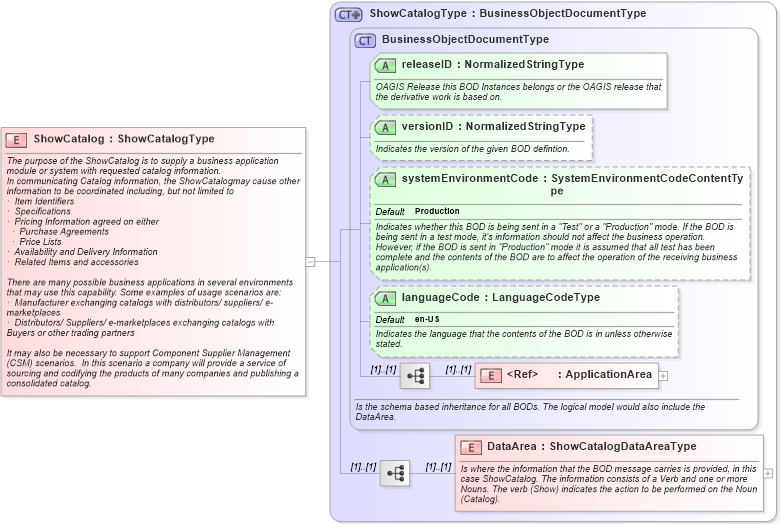
Drilldown into DataArea in schema showcatalog_xsd Drilldown into ApplicationArea in schema meta_xsd Drilldown into languageCode in schema meta_xsd Drilldown into systemEnvironmentCode in schema meta_xsd Drilldown into versionID in schema meta_xsd Drilldown into releaseID in schema meta_xsd Drilldown into BusinessObjectDocumentType in schema meta_xsd Drilldown into ShowCatalogType in schema showcatalog_xsdXSD Diagram of ShowCatalog in schema showcatalog_xsd (Open Applications Group (OAGIS))
Collapse XSD Schema Code:
<xsd:element name="ShowCatalog" type="ShowCatalogType">
    <xsd:annotation>
        <xsd:documentation source="http://www.openapplications.org/oagis/9">The purpose of the ShowCatalog is to supply a business application module or system with requested catalog information.
In communicating Catalog information, the ShowCatalogmay cause other information to be coordinated including, but not limited to
·  Item Identifiers
·  Specifications
·  Pricing Information agreed on either
  ·  Purchase Agreements
  ·  Price Lists
·  Availability and Delivery Information
·  Related Items and accessories

There are many possible business applications in several environments that may use this capability. Some examples of usage scenarios are:
·  Manufacturer exchanging catalogs with distributors/ suppliers/ e-marketplaces
·  Distributors/ Suppliers/ e-marketplaces exchanging catalogs with Buyers or other trading partners

It may also be necessary to support Component Supplier Management (CSM) scenarios.  In this scenario a company will provide a service of sourcing and codifying the products of many companies and publishing a consolidated catalog. </xsd:documentation>
    </xsd:annotation>
</xsd:element>
Collapse Child Elements:
Name Type Min Occurs Max Occurs
ApplicationArea nsA:ApplicationArea (1) (1)
DataArea nsA:DataArea (1) (1)
Collapse Child Attributes:
Name Type Default Value Use
releaseID nsA:releaseID Required
versionID nsA:versionID Optional
systemEnvironmentCode nsA:systemEnvironmentCode Production Optional
languageCode nsA:languageCode en-US Optional
Collapse Derivation Tree: