Definition Type: Element
Name: SyncEngineeringChangeOrder
Namespace: http://www.openapplications.org/oagis/9
Type: nsA:SyncEngineeringChangeOrderType
Containing Schema: SyncEngineeringChangeOrder.xsd
Abstract
Documentation:
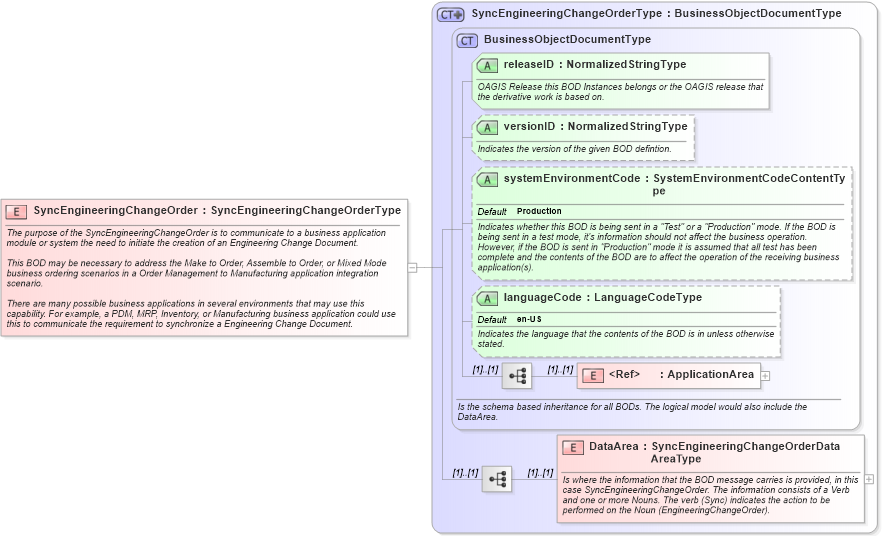
The purpose of the SyncEngineeringChangeOrder is to communicate to a business application module or system the need to initiate the creation of an Engineering Change Document. This BOD may be necessary to address the Make to Order, Assemble to Order, or Mixed Mode business ordering scenarios in a Order Management to Manufacturing application integration scenario. There are many possible business applications in several environments that may use this capability. For example, a PDM, MRP, Inventory, or Manufacturing business application could use this to communicate the requirement to synchronize a Engineering Change Document.
Collapse XSD Schema Diagram:
Drilldown into DataArea in schema syncengineeringchangeorder_xsd Drilldown into ApplicationArea in schema meta_xsd Drilldown into languageCode in schema meta_xsd Drilldown into systemEnvironmentCode in schema meta_xsd Drilldown into versionID in schema meta_xsd Drilldown into releaseID in schema meta_xsd Drilldown into BusinessObjectDocumentType in schema meta_xsd Drilldown into SyncEngineeringChangeOrderType in schema syncengineeringchangeorder_xsdXSD Diagram of SyncEngineeringChangeOrder in schema syncengineeringchangeorder_xsd (Open Applications Group (OAGIS))
Collapse XSD Schema Code:
<xsd:element name="SyncEngineeringChangeOrder" type="SyncEngineeringChangeOrderType">
    <xsd:annotation>
        <xsd:documentation source="http://www.openapplications.org/oagis/9">The purpose of the SyncEngineeringChangeOrder is to communicate to a business application module or system the need to initiate the creation of an Engineering Change Document.

This BOD may be necessary to address the Make to Order, Assemble to Order, or Mixed Mode business ordering scenarios in a Order Management to Manufacturing application integration scenario.

There are many possible business applications in several environments that may use this capability. For example, a PDM, MRP, Inventory, or Manufacturing business application could use this to communicate the requirement to synchronize a Engineering Change Document.
</xsd:documentation>
    </xsd:annotation>
</xsd:element>
Collapse Child Elements:
Name Type Min Occurs Max Occurs
ApplicationArea nsA:ApplicationArea (1) (1)
DataArea nsA:DataArea (1) (1)
Collapse Child Attributes:
Name Type Default Value Use
releaseID nsA:releaseID Required
versionID nsA:versionID Optional
systemEnvironmentCode nsA:systemEnvironmentCode Production Optional
languageCode nsA:languageCode en-US Optional
Collapse Derivation Tree: