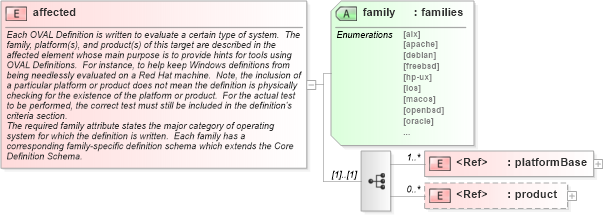
<xsd:element name="affected">
    <xsd:annotation>
        <xsd:documentation>Each OVAL Definition is written to evaluate a certain type of system.  The family, platform(s), and product(s) of this target are described in the affected element whose main purpose is to provide hints for tools using OVAL Definitions.  For instance, to help keep Windows definitions from being needlessly evaluated on a Red Hat machine.  Note, the inclusion of a particular platform or product does not mean the definition is physically checking for the existence of the platform or product.  For the actual test to be performed, the correct test must still be included in the definition's criteria section.</xsd:documentation>
        <xsd:documentation>The required family attribute states the major category of operating system for which the definition is written.  Each family has a corresponding family-specific definition schema which extends the Core Definition Schema.</xsd:documentation>
        <xsd:appinfo>
            <cardinality>0-1</cardinality>
            <attributes>family</attributes>
            <content>none</content>
            <parent_elements>definition</parent_elements>
            <child_elements>platform, [product]</child_elements>
        </xsd:appinfo>
    </xsd:annotation>
    <xsd:complexType>
        <xsd:sequence>
            <xsd:element ref="oval:platformBase" minOccurs="1" maxOccurs="unbounded" />
            <xsd:element ref="oval:product" minOccurs="0" maxOccurs="unbounded" />
        </xsd:sequence>
        <xsd:attribute name="family" type="oval:families" use="required" />
    </xsd:complexType>
</xsd:element>
|
 XSD Schema Diagram: