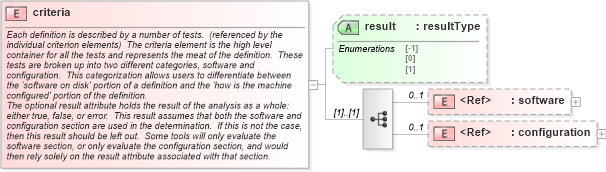
<xsd:element name="criteria">
    <xsd:annotation>
        <xsd:documentation>Each definition is described by a number of tests.  (referenced by the individual criterion elements)  The criteria element is the high level container for all the tests and represents the meat of the definition.  These tests are broken up into two different categories, software and configuration.  This categorization allows users to differentiate between the 'software on disk' portion of a definition and the 'how is the machine configured' portion of the definition.</xsd:documentation>
        <xsd:documentation>The optional result attribute holds the result of the analysis as a whole: either true, false, or error.  This result assumes that both the software and configuration section are used in the determination.  If this is not the case, then this result should be left out.  Some tools will only evaluate the software section, or only evaluate the configuration section, and would then rely solely on the result attribute associated with that section.</xsd:documentation>
        <xsd:appinfo>
            <cardinality>0-1</cardinality>
            <attributes>result</attributes>
            <content>none</content>
            <parent_elements>definition</parent_elements>
            <child_elements>software, configuration</child_elements>
        </xsd:appinfo>
    </xsd:annotation>
    <xsd:complexType>
        <xsd:sequence>
            <xsd:element ref="oval_results:software" minOccurs="0" maxOccurs="1" />
            <xsd:element ref="oval_results:configuration" minOccurs="0" maxOccurs="1" />
        </xsd:sequence>
        <xsd:attribute name="result" type="oval_results:resultType" use="optional" />
    </xsd:complexType>
</xsd:element>
|
 XSD Schema Diagram: