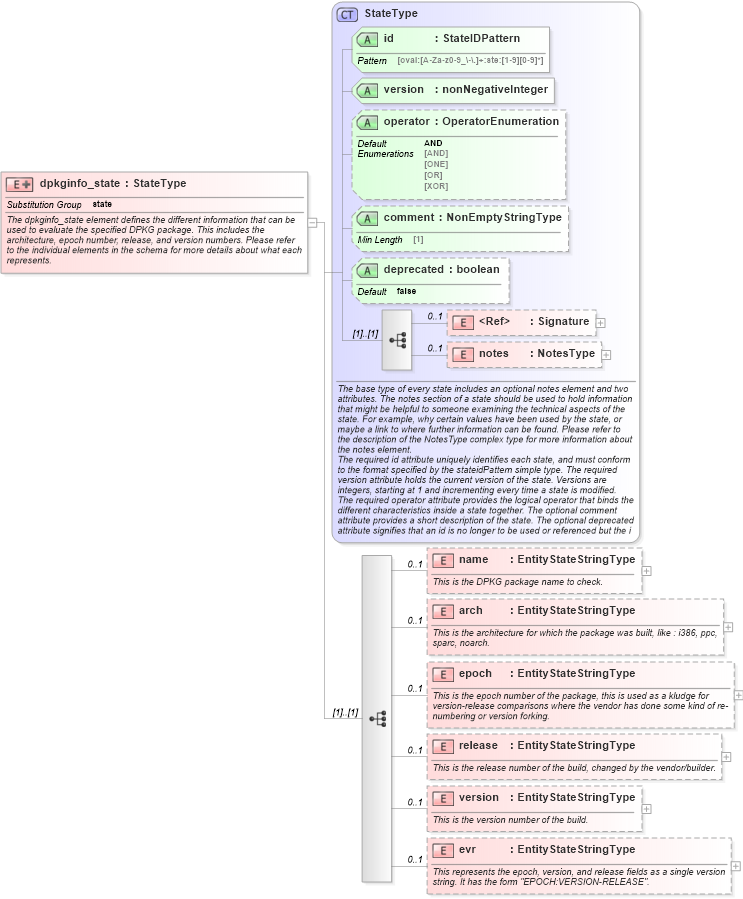
<xsd:element name="dpkginfo_state" substitutionGroup="oval-def:state">
    <xsd:annotation>
        <xsd:documentation>The dpkginfo_state element defines the different information that can be used to evaluate the specified DPKG package. This includes the architecture, epoch number, release, and version numbers. Please refer to the individual elements in the schema for more details about what each represents.</xsd:documentation>
    </xsd:annotation>
    <xsd:complexType>
        <xsd:complexContent>
            <xsd:extension base="oval-def:StateType">
                <xsd:sequence>
                    <xsd:element name="name" type="oval-def:EntityStateStringType" minOccurs="0" maxOccurs="1">
                        <xsd:annotation>
                            <xsd:documentation>This is the DPKG package name to check.</xsd:documentation>
                            <xsd:appinfo>
                                <sch:pattern id="dpkgstename" xmlns:sch="http://purl.oclc.org/dsdl/schematron">
                                    <sch:rule context="linux-def:dpkginfo_state/linux-def:name">
                                        <sch:assert test="not(@datatype) or @datatype='string'">
                                            <sch:value-of select="../@id" /> - datatype attribute for the name entity of a dpkginfo_state should be 'string'</sch:assert>
                                        <sch:assert test="not(@operation) or @operation='equals' or @operation='not equal' or @operation='pattern match'">
                                            <sch:value-of select="../@id" /> - operation attribute for the name entity of a dpkginfo_state should be 'equals', 'not equal', or 'pattern match'</sch:assert>
                                    </sch:rule>
                                </sch:pattern>
                            </xsd:appinfo>
                        </xsd:annotation>
                    </xsd:element>
                    <xsd:element name="arch" type="oval-def:EntityStateStringType" minOccurs="0" maxOccurs="1">
                        <xsd:annotation>
                            <xsd:documentation>This is the architecture for which the package was built, like : i386, ppc, sparc, noarch.</xsd:documentation>
                            <xsd:appinfo>
                                <sch:pattern id="dpkgstearch" xmlns:sch="http://purl.oclc.org/dsdl/schematron">
                                    <sch:rule context="linux-def:dpkginfo_state/linux-def:arch">
                                        <sch:assert test="not(@datatype) or @datatype='string'">
                                            <sch:value-of select="../@id" /> - datatype attribute for the arch entity of a dpkginfo_state should be 'string'</sch:assert>
                                        <sch:assert test="not(@operation) or @operation='equals' or @operation='not equal' or @operation='pattern match'">
                                            <sch:value-of select="../@id" /> - operation attribute for the arch entity of a dpkginfo_state should be 'equals', 'not equal', or 'pattern match'</sch:assert>
                                    </sch:rule>
                                </sch:pattern>
                            </xsd:appinfo>
                        </xsd:annotation>
                    </xsd:element>
                    <xsd:element name="epoch" type="oval-def:EntityStateStringType" minOccurs="0" maxOccurs="1">
                        <xsd:annotation>
                            <xsd:documentation>This is the epoch number of the package, this is used as a kludge for version-release comparisons where the vendor has done some kind of re-numbering or version forking.</xsd:documentation>
                            <xsd:appinfo>
                                <sch:pattern id="dpkgsteepoch" xmlns:sch="http://purl.oclc.org/dsdl/schematron">
                                    <sch:rule context="linux-def:dpkginfo_state/linux-def:epoch">
                                        <sch:assert test="not(@datatype) or @datatype='string'">
                                            <sch:value-of select="../@id" /> - datatype attribute for the epoch entity of a dpkginfo_state should be 'string'</sch:assert>
                                        <sch:assert test="not(@operation) or @operation='equals' or @operation='not equal' or @operation='greater than' or @operation='greater than or equal' or @operation='less than' or @operation='less than or equal' or 'pattern match'">
                                            <sch:value-of select="../@id" /> - operation attribute for the epoch entity of a dpkginfo_state should be 'equals', 'not equal', 'greater than', 'greater than or equal', 'less than', 'less than or equal', or 'pattern match'</sch:assert>
                                    </sch:rule>
                                </sch:pattern>
                            </xsd:appinfo>
                        </xsd:annotation>
                    </xsd:element>
                    <xsd:element name="release" type="oval-def:EntityStateStringType" minOccurs="0" maxOccurs="1">
                        <xsd:annotation>
                            <xsd:documentation>This is the release number of the build, changed by the vendor/builder.</xsd:documentation>
                            <xsd:appinfo>
                                <sch:pattern id="dpkgsterelease" xmlns:sch="http://purl.oclc.org/dsdl/schematron">
                                    <sch:rule context="linux-def:dpkginfo_state/linux-def:release">
                                        <sch:assert test="not(@datatype) or @datatype='string'">
                                            <sch:value-of select="../@id" /> - datatype attribute for the release entity of a dpkginfo_state should be 'string'</sch:assert>
                                        <sch:assert test="not(@operation) or @operation='equals' or @operation='not equal' or @operation='greater than' or @operation='greater than or equal' or @operation='less than' or @operation='less than or equal' or 'pattern match'">
                                            <sch:value-of select="../@id" /> - operation attribute for the release entity of a dpkginfo_state should be 'equals', 'not equal', 'greater than', 'greater than or equal', 'less than', 'less than or equal', or 'pattern match'</sch:assert>
                                    </sch:rule>
                                </sch:pattern>
                            </xsd:appinfo>
                        </xsd:annotation>
                    </xsd:element>
                    <xsd:element name="version" type="oval-def:EntityStateStringType" minOccurs="0" maxOccurs="1">
                        <xsd:annotation>
                            <xsd:documentation>This is the version number of the build.</xsd:documentation>
                            <xsd:appinfo>
                                <sch:pattern id="dpkgsteversion" xmlns:sch="http://purl.oclc.org/dsdl/schematron">
                                    <sch:rule context="linux-def:dpkginfo_state/linux-def:version">
                                        <sch:assert test="not(@datatype) or @datatype='string'">
                                            <sch:value-of select="../@id" /> - datatype attribute for the version entity of a dpkginfo_state should be 'string'</sch:assert>
                                        <sch:assert test="not(@operation) or @operation='equals' or @operation='not equal' or @operation='greater than' or @operation='greater than or equal' or @operation='less than' or @operation='less than or equal' or 'pattern match'">
                                            <sch:value-of select="../@id" /> - operation attribute for the version entity of a dpkginfo_state should be 'equals', 'not equal', 'greater than', 'greater than or equal', 'less than', 'less than or equal', or 'pattern match'</sch:assert>
                                    </sch:rule>
                                </sch:pattern>
                            </xsd:appinfo>
                        </xsd:annotation>
                    </xsd:element>
                    <xsd:element name="evr" type="oval-def:EntityStateStringType" minOccurs="0" maxOccurs="1">
                        <xsd:annotation>
                            <xsd:documentation>This represents the epoch, version, and release fields as a single version string. It has the form "EPOCH:VERSION-RELEASE".</xsd:documentation>
                            <xsd:appinfo>
                                <sch:pattern id="dpkgsteevr" xmlns:sch="http://purl.oclc.org/dsdl/schematron">
                                    <sch:rule context="linux-def:dpkginfo_state/linux-def:evr">
                                        <sch:assert test="not(@datatype) or @datatype='evr_string'">
                                            <sch:value-of select="../@id" /> - datatype attribute for the evr entity of a dpkginfo_state should be 'evr_string'</sch:assert>
                                        <sch:assert test="not(@operation) or @operation='equals' or @operation='not equal' or @operation='greater than' or @operation='greater than or equal' or @operation='less than' or @operation='less than or equal' or 'pattern match'">
                                            <sch:value-of select="../@id" /> - operation attribute for the evr entity of a dpkginfo_state should be 'equals', 'not equal', 'greater than', 'greater than or equal', 'less than', 'less than or equal', or 'pattern match'</sch:assert>
                                    </sch:rule>
                                </sch:pattern>
                            </xsd:appinfo>
                        </xsd:annotation>
                    </xsd:element>
                </xsd:sequence>
            </xsd:extension>
        </xsd:complexContent>
    </xsd:complexType>
</xsd:element>
|
 XSD Schema Diagram: