Definition Type: Group
Name: FunctionGroup
Namespace: http://oval.mitre.org/XMLSchema/oval-definitions-5
Containing Schema: oval-definitions-schema.xsd
Documentation:
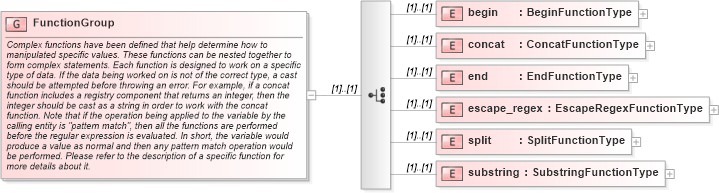
Complex functions have been defined that help determine how to manipulated specific values. These functions can be nested together to form complex statements. Each function is designed to work on a specific type of data. If the data being worked on is not of the correct type, a cast should be attempted before throwing an error. For example, if a concat function includes a registry component that returns an integer, then the integer should be cast as a string in order to work with the concat function. Note that if the operation being applied to the variable by the calling entity is "pattern match", then all the functions are performed before the regular expression is evaluated. In short, the variable would produce a value as normal and then any pattern match operation would be performed. Please refer to the description of a specific function for more details about it.
Collapse XSD Schema Diagram:
Drilldown into substring in schema oval-definitions-schema_xsd Drilldown into split in schema oval-definitions-schema_xsd Drilldown into escape_regex in schema oval-definitions-schema_xsd Drilldown into end in schema oval-definitions-schema_xsd Drilldown into concat in schema oval-definitions-schema_xsd Drilldown into begin in schema oval-definitions-schema_xsdXSD Diagram of FunctionGroup in schema oval-definitions-schema_xsd (Open Vulnerability and Assessment Language (OVAL®))
Collapse XSD Schema Code:
<xsd:group name="FunctionGroup">
    <xsd:annotation>
        <xsd:documentation>Complex functions have been defined that help determine how to manipulated specific values. These functions can be nested together to form complex statements. Each function is designed to work on a specific type of data. If the data being worked on is not of the correct type, a cast should be attempted before throwing an error. For example, if a concat function includes a registry component that returns an integer, then the integer should be cast as a string in order to work with the concat function. Note that if the operation being applied to the variable by the calling entity is "pattern match", then all the functions are performed before the regular expression is evaluated. In short, the variable would produce a value as normal and then any pattern match operation would be performed. Please refer to the description of a specific function for more details about it.</xsd:documentation>
    </xsd:annotation>
    <xsd:choice>
        <xsd:element name="begin" type="oval-def:BeginFunctionType" />
        <xsd:element name="concat" type="oval-def:ConcatFunctionType" />
        <xsd:element name="end" type="oval-def:EndFunctionType" />
        <xsd:element name="escape_regex" type="oval-def:EscapeRegexFunctionType" />
        <xsd:element name="split" type="oval-def:SplitFunctionType" />
        <xsd:element name="substring" type="oval-def:SubstringFunctionType" />
    </xsd:choice>
</xsd:group>
Collapse Child Elements:
Name Type Min Occurs Max Occurs
begin oval-def:begin (1) (1)
concat oval-def:concat (1) (1)
end oval-def:end (1) (1)
escape_regex oval-def:escape_regex (1) (1)
split oval-def:split (1) (1)
substring oval-def:substring (1) (1)