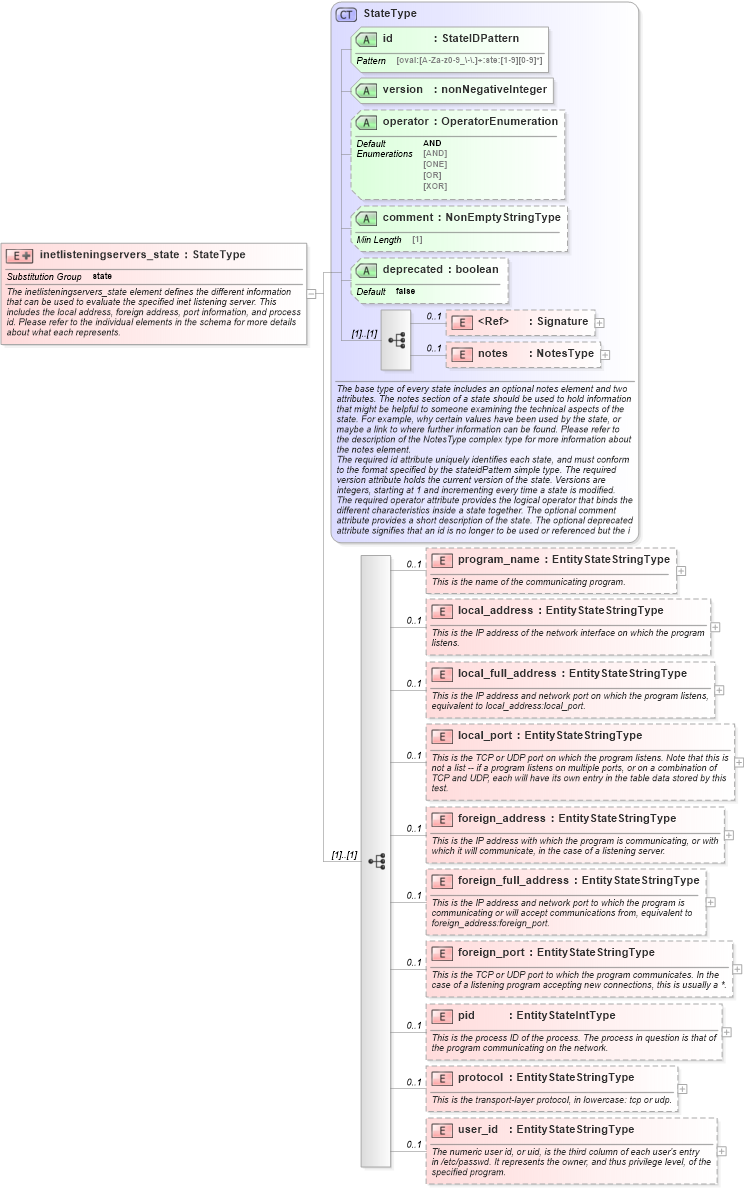
<xsd:element name="inetlisteningservers_state" substitutionGroup="oval-def:state">
    <xsd:annotation>
        <xsd:documentation>The inetlisteningservers_state element defines the different information that can be used to evaluate the specified inet listening server. This includes the local address, foreign address, port information, and process id. Please refer to the individual elements in the schema for more details about what each represents.</xsd:documentation>
    </xsd:annotation>
    <xsd:complexType>
        <xsd:complexContent>
            <xsd:extension base="oval-def:StateType">
                <xsd:sequence>
                    <xsd:element name="program_name" type="oval-def:EntityStateStringType" minOccurs="0" maxOccurs="1">
                        <xsd:annotation>
                            <xsd:documentation>This is the name of the communicating program.</xsd:documentation>
                            <xsd:appinfo>
                                <sch:pattern id="macosilssteprogram_name" xmlns:sch="http://purl.oclc.org/dsdl/schematron">
                                    <sch:rule context="macos-def:inetlisteningservers_state/macos-def:program_name">
                                        <sch:assert test="not(@datatype) or @datatype='string'">
                                            <sch:value-of select="../@id" /> - datatype attribute for the program_name entity of an inetlisteningservers_state should be 'string'</sch:assert>
                                    </sch:rule>
                                </sch:pattern>
                            </xsd:appinfo>
                        </xsd:annotation>
                    </xsd:element>
                    <xsd:element name="local_address" type="oval-def:EntityStateStringType" minOccurs="0" maxOccurs="1">
                        <xsd:annotation>
                            <xsd:documentation>This is the IP address of the network interface on which the program listens.</xsd:documentation>
                            <xsd:appinfo>
                                <sch:pattern id="macosilsstelocal_address" xmlns:sch="http://purl.oclc.org/dsdl/schematron">
                                    <sch:rule context="macos-def:inetlisteningservers_state/macos-def:local_address">
                                        <sch:assert test="not(@datatype) or @datatype='string'">
                                            <sch:value-of select="../@id" /> - datatype attribute for the local_address entity of an inetlisteningservers_state should be 'string'</sch:assert>
                                    </sch:rule>
                                </sch:pattern>
                            </xsd:appinfo>
                        </xsd:annotation>
                    </xsd:element>
                    <xsd:element name="local_full_address" type="oval-def:EntityStateStringType" minOccurs="0" maxOccurs="1">
                        <xsd:annotation>
                            <xsd:documentation>This is the IP address and network port on which the program listens, equivalent to local_address:local_port.</xsd:documentation>
                            <xsd:appinfo>
                                <sch:pattern id="macosilsstelocal_full_address" xmlns:sch="http://purl.oclc.org/dsdl/schematron">
                                    <sch:rule context="macos-def:inetlisteningservers_state/macos-def:local_full_address">
                                        <sch:assert test="not(@datatype) or @datatype='string'">
                                            <sch:value-of select="../@id" /> - datatype attribute for the local_full_address entity of an inetlisteningservers_state should be 'string'</sch:assert>
                                    </sch:rule>
                                </sch:pattern>
                            </xsd:appinfo>
                        </xsd:annotation>
                    </xsd:element>
                    <xsd:element name="local_port" type="oval-def:EntityStateStringType" minOccurs="0" maxOccurs="1">
                        <xsd:annotation>
                            <xsd:documentation>This is the TCP or UDP port on which the program listens. Note that this is not a list -- if a program listens on multiple ports, or on a combination of TCP and UDP, each will have its own entry in the table data stored by this test.</xsd:documentation>
                            <xsd:appinfo>
                                <sch:pattern id="macosilsstelocal_port" xmlns:sch="http://purl.oclc.org/dsdl/schematron">
                                    <sch:rule context="macos-def:inetlisteningservers_state/macos-def:local_port">
                                        <sch:assert test="not(@datatype) or @datatype='string'">
                                            <sch:value-of select="../@id" /> - datatype attribute for the local_port entity of an inetlisteningservers_state should be 'string'</sch:assert>
                                    </sch:rule>
                                </sch:pattern>
                            </xsd:appinfo>
                        </xsd:annotation>
                    </xsd:element>
                    <xsd:element name="foreign_address" type="oval-def:EntityStateStringType" minOccurs="0" maxOccurs="1">
                        <xsd:annotation>
                            <xsd:documentation>This is the IP address with which the program is communicating, or with which it will communicate, in the case of a listening server.</xsd:documentation>
                            <xsd:appinfo>
                                <sch:pattern id="macosilssteforeign_address" xmlns:sch="http://purl.oclc.org/dsdl/schematron">
                                    <sch:rule context="macos-def:inetlisteningservers_state/macos-def:foreign_address">
                                        <sch:assert test="not(@datatype) or @datatype='string'">
                                            <sch:value-of select="../@id" /> - datatype attribute for the foreign_address entity of an inetlisteningservers_state should be 'string'</sch:assert>
                                    </sch:rule>
                                </sch:pattern>
                            </xsd:appinfo>
                        </xsd:annotation>
                    </xsd:element>
                    <xsd:element name="foreign_full_address" type="oval-def:EntityStateStringType" minOccurs="0" maxOccurs="1">
                        <xsd:annotation>
                            <xsd:documentation>This is the IP address and network port to which the program is communicating or will accept communications from, equivalent to foreign_address:foreign_port.</xsd:documentation>
                            <xsd:appinfo>
                                <sch:pattern id="macosilssteforeign_full_address" xmlns:sch="http://purl.oclc.org/dsdl/schematron">
                                    <sch:rule context="macos-def:inetlisteningservers_state/macos-def:foreign_full_address">
                                        <sch:assert test="not(@datatype) or @datatype='string'">
                                            <sch:value-of select="../@id" /> - datatype attribute for the foreign_full_address entity of an inetlisteningservers_state should be 'string'</sch:assert>
                                    </sch:rule>
                                </sch:pattern>
                            </xsd:appinfo>
                        </xsd:annotation>
                    </xsd:element>
                    <xsd:element name="foreign_port" type="oval-def:EntityStateStringType" minOccurs="0" maxOccurs="1">
                        <xsd:annotation>
                            <xsd:documentation>This is the TCP or UDP port to which the program communicates. In the case of a listening program accepting new connections, this is usually a *.</xsd:documentation>
                            <xsd:appinfo>
                                <sch:pattern id="macosilssteforeign_port" xmlns:sch="http://purl.oclc.org/dsdl/schematron">
                                    <sch:rule context="macos-def:inetlisteningservers_state/macos-def:foreign_port">
                                        <sch:assert test="not(@datatype) or @datatype='string'">
                                            <sch:value-of select="../@id" /> - datatype attribute for the foreign_port entity of an inetlisteningservers_state should be 'string'</sch:assert>
                                    </sch:rule>
                                </sch:pattern>
                            </xsd:appinfo>
                        </xsd:annotation>
                    </xsd:element>
                    <xsd:element name="pid" type="oval-def:EntityStateIntType" minOccurs="0" maxOccurs="1">
                        <xsd:annotation>
                            <xsd:documentation>This is the process ID of the process. The process in question is that of the program communicating on the network.</xsd:documentation>
                            <xsd:appinfo>
                                <sch:pattern id="macosilsstepid" xmlns:sch="http://purl.oclc.org/dsdl/schematron">
                                    <sch:rule context="macos-def:inetlisteningservers_state/macos-def:pid">
                                        <sch:assert test="not(@datatype) or @datatype='int'">
                                            <sch:value-of select="../@id" /> - datatype attribute for the pid entity of an inetlisteningservers_state should be 'int'</sch:assert>
                                    </sch:rule>
                                </sch:pattern>
                            </xsd:appinfo>
                        </xsd:annotation>
                    </xsd:element>
                    <xsd:element name="protocol" type="oval-def:EntityStateStringType" minOccurs="0" maxOccurs="1">
                        <xsd:annotation>
                            <xsd:documentation>This is the transport-layer protocol, in lowercase: tcp or udp.</xsd:documentation>
                            <xsd:appinfo>
                                <sch:pattern id="macosilssteprotocol" xmlns:sch="http://purl.oclc.org/dsdl/schematron">
                                    <sch:rule context="macos-def:inetlisteningservers_state/macos-def:protocol">
                                        <sch:assert test="not(@datatype) or @datatype='string'">
                                            <sch:value-of select="../@id" /> - datatype attribute for the protocol entity of an inetlisteningservers_state should be 'string'</sch:assert>
                                    </sch:rule>
                                </sch:pattern>
                            </xsd:appinfo>
                        </xsd:annotation>
                    </xsd:element>
                    <xsd:element name="user_id" type="oval-def:EntityStateStringType" minOccurs="0" maxOccurs="1">
                        <xsd:annotation>
                            <xsd:documentation>The numeric user id, or uid, is the third column of each user's entry in /etc/passwd. It represents the owner, and thus privilege level, of the specified program.</xsd:documentation>
                            <xsd:appinfo>
                                <sch:pattern id="macosilssteuser_id" xmlns:sch="http://purl.oclc.org/dsdl/schematron">
                                    <sch:rule context="macos-def:inetlisteningservers_state/macos-def:user_id">
                                        <sch:assert test="not(@datatype) or @datatype='string'">
                                            <sch:value-of select="../@id" /> - datatype attribute for the user_id entity of an inetlisteningservers_state should be 'string'</sch:assert>
                                    </sch:rule>
                                </sch:pattern>
                            </xsd:appinfo>
                        </xsd:annotation>
                    </xsd:element>
                </xsd:sequence>
            </xsd:extension>
        </xsd:complexContent>
    </xsd:complexType>
</xsd:element>
|
 XSD Schema Diagram: